
BlackBox IC1023A USB hub 8-port RS23
Networks > Media-Converters
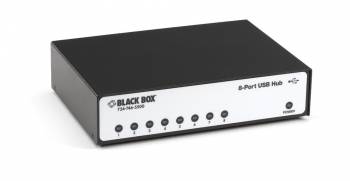
BlackBox IC1023A USB hub 8-port RS23
| Lieske Part No. | 449391 |
|---|---|
| Mfg Part No | IC1023A |
| EAN-Code | |
| Manufacturer | BlackBox |
| Here only | 690,24 EUR
821,39 EUR incl. VAT
|
Further information for BlackBox IC1023A USB hub 8-port RS23
| General | |
| Number of serial ports | 8 |
| Serial interface | DB9 M (DTE) |
| USB interface | Type B |
| Maximum data rate RS-422/485 | 921 kbps |
| Maximum data rate RS-232/V.24 | 460 kbps |
| FIFO transmit buffer | 128 Byte |
| FIFO receive buffer | 384 Byte |
| Operating systems | Windows 98, Windows Me, Windows 2000, Windows XP |
| Scope of delivery | USB hub, CD with user manual and software, 1.8 m USB cable |
Applications
This USB hub is intended for connecting serial peripheral devices to PCs or notebooks, particularly in environments requiring multiple serial ports. It is suitable for applications in manufacturing, logistics, warehouse management, or office settings, where devices such as barcode scanners, industrial printers, or measuring instruments communicate via serial interfaces. The hot-swap capability allows installation without shutting down the computer, ensuring uninterrupted operation.
Functions and Features in Detail
The hub features eight serial connections in the form of DB9-M connectors (DTE), each individually configurable via internal DIP switches. Communication is handled via a high-speed UART with a 128-byte FIFO transmit buffer and a 384-byte FIFO receive buffer, enabling high data rates and low latency. The maximum transmission rate is 921 kbps for RS-422/485 and 460 kbps for RS-232/V.24. Support for automatic RS-485 data enable/disable simplifies communication in multi-point networks. The DB9 connector is backward compatible with PCI- and ISA-based RS-422 products.
Technology Explained Simply
The integrated USB interface (Type B) provides power and data transmission through the USB bus system. Power is supplied directly via the USB connection, provided it is connected to a powered PC or a USB hub. The high-speed UART technology ensures efficient data processing, with FIFO buffers stabilizing data transmission and preventing buffer overflows. The serial connections are implemented as DB9-M connectors, representing a standard interface for industrial and office applications.
Compatibility and Accessories
The hub is designed for operating systems Windows 98, Windows Me, Windows 2000, and Windows XP. The required drivers, utilities, and support files are included on an accompanying CD. Installation is plug-and-play, with the hub configuring itself automatically. The delivery includes the USB hub, a CD with user manual and installation software, and a 1.8 m USB cable. Compatibility with serial devices is ensured through support for RS-232/V.24, RS-422, and RS-485 standards.
Mounting and Installation
Installation requires no tools. The hub is connected to a USB port on the computer using the USB cable, and the serial devices are connected to the DB9 ports. The software is installed from the included CD, with the hub configuring itself automatically. The hot-swap capability allows installation and removal during operation.
Advantages in Operation
The USB hub provides a reliable and fast connection for serial devices without requiring internal adapter cards. The plug-and-play function and automatic configuration reduce setup time. Support for RS-485 with automatic data enable/disable is suitable for industrial applications involving multiple devices. Powering via USB reduces the need for additional power supplies.

This is an offer of:
79279 Vörstetten
https://industry-electronics.com
Tel. 07666/88499-0
Fax. 07666/88499-111
Diesen Artikel finden Sie unter:
industry-electronics.com/artikel/449391

Lieske Elektronik e.K.
Reutener Str. 1079279 Vörstetten
https://industry-electronics.com
Tel. 07666/88499-0
Fax. 07666/88499-111
Diesen Artikel finden Sie unter:
industry-electronics.com/artikel/449391