
BlackBox ACX1MT-AR KVM transmitter bidirectional
Accessories > KVM > KVM-Extender
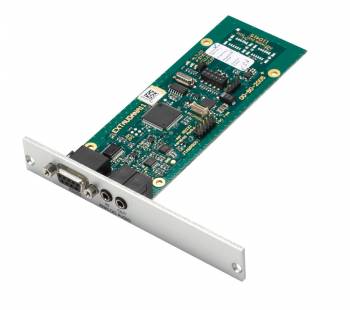
BlackBox ACX1MT-AR KVM transmitter bidirectional
| Lieske Part No. | 555750 |
|---|---|
| Mfg Part No | ACX1MT-AR |
| EAN-Code | |
| Manufacturer | BlackBox |
| Here only | 128,64 EUR
153,08 EUR incl. VAT
|
Further information for BlackBox ACX1MT-AR KVM transmitter bidirectional
| General | |
| Connections | 2 x 3.5 mm audio jacks, 1 x DB9 female connector (serial) |
| Signal transmission | via base board in housing |
| Compatibility | Modular DKM KVM extender housing with 2, 4, 6 or 21 slots |
| Interfaces | Bidirectional analog audio, serial RS-232 |
Applications
The ACX1MT-AR is suitable for applications requiring additional serial communication and audio functions over KVM connections. Typical use cases include controlling industrial devices, connecting serial sensors, or accessing audio sources in distributed systems. It is particularly suited for point-to-point extensions where the computer is physically separated from the control console, and for systems working with KVM matrix switches from the DKM FX or DKM FXC series. Combining it with other modules enables the creation of a scalable and flexible switching system for enterprise resources.
Functions and Equipment in Detail
The module features two 3.5 mm audio jacks for bidirectional analog audio transmission, enabling sound transmission to and from the connected console. Additionally, a DB9 jack for serial RS-232 data connection is integrated. This interface is commonly used in industrial environments or with devices featuring serial control. Signals are transmitted via the base board within the housing, so the module does not require its own cable connection to the opposite side. Integration occurs in a modular housing that must be equipped with a base board providing at least one video channel and two USB HID connections.
Technology Explained Simply
The ACX1MT-AR operates as an expansion module within a modular DKM KVM extender. It uses the existing signal infrastructure of the base board to transmit additional peripheral signals. Bidirectional audio transmission allows sound to be transmitted in both directions — from the console to the computer and vice versa. The serial RS-232 interface supports data transmission using standard protocols commonly found in many industrial and technical devices. The modular design allows flexible adaptation to different system requirements without requiring additional cables or connections.
Compatibility and Accessories
The module is designed for use in modular DKM KVM extender housings that include at least a base board with video and USB HID interfaces. It is compatible with desktop and 19-inch rack housings with 2, 4, 6, or 21 slots. The housings can be equipped with internal or external power supplies and AC or DC power (12, 24, or 48 VDC). Optional mounting kits are available to mount desktop housings on the wall, under the desk, on a DIN rail, or in a 19-inch IT enclosure. Modularity allows combination with other expansion modules, such as USB HID or switching modules, to create a comprehensive peripheral system.
Installation and Mounting
Installation is performed by inserting the module into an available slot in the modular DKM extender housing. Signal connections are made via the base board, so no additional cabling between the module and the opposite side is required. The housing can be mounted on a desk or in a 19-inch rack, with optional mounting kits available for wall or DIN rail mounting. Configuration is achieved by selecting the appropriate base board and additional modules to realize the desired functions.
Operational Advantages
The ACX1MT-AR reduces cabling requirements, as it does not need its own cable connection to the opposite side. The modular design enables flexible expansion of system functions without modifying existing infrastructure. Bidirectional audio and serial data transmission extend the functionality of KVM systems, especially in industrial or technical environments where additional peripheral interfaces are required. Compatibility with various housing formats and power supply options increases flexibility in system planning. Integration into existing DKM systems occurs without requiring additional hardware or software modifications.

This is an offer of:
79279 Vörstetten
https://industry-electronics.com
Tel. 07666/88499-0
Fax. 07666/88499-111
Diesen Artikel finden Sie unter:
industry-electronics.com/artikel/555750

Lieske Elektronik e.K.
Reutener Str. 1079279 Vörstetten
https://industry-electronics.com
Tel. 07666/88499-0
Fax. 07666/88499-111
Diesen Artikel finden Sie unter:
industry-electronics.com/artikel/555750