
Bernstein 6085103100 BI2-U1Z W limit switch ISO
Industrial Material > Control devices / Pilot devices > Limit switches, mechanical
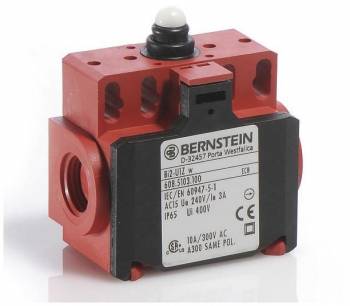
Bernstein 6085103100 BI2-U1Z W limit switch ISO
| Lieske Part No. | 370326 |
|---|---|
| Mfg Part No | 6085103100 |
| EAN-Code | 4024337035456 |
| Manufacturer | Bernstein |
| Here only | 34,25 EUR
40,76 EUR incl. VAT
|
Further information for Bernstein 6085103100 BI2-U1Z W limit switch ISO
| General | |
| Manufacturer | Bernstein |
| Product type | Limit switch |
| Construction type | encapsulated in insulating material |
| Actuating element | plunger |
| Cable entries | 2 |
Limit switches are commonly used in automation technology to detect the end point of a movement, for example in linear drives, sliding doors, or conveyor belts. The BI2-U1Z W features a plunger as the actuating element, which is triggered by a mechanical movement. The configuration as a normally open/normally closed (NO/NC) switch enables control circuit actuation, with the switch opening or closing the circuit depending on actuation.
Insulating material-encapsulated means that the switch housing is made of a non-conductive material that simultaneously resists mechanical stress and environmental conditions such as moisture or dust. This design is typical for robust industrial switches used in harsh operating environments. The encapsulation protects internal contacts and prevents short circuits.
Two cable entries are a key advantage of this model. They enable flexible and efficient cabling, especially when multiple switches are mounted in a row. This allows cabling to be routed directly from switch to switch via the entries, simplifying installation and reducing the number of required connection points. This is particularly beneficial in systems with multiple position switches, such as those found in manufacturing technology or packaging machines.
The cable entries are designed to ensure a secure and durable connection to the connecting cable. They are suitable for use with standard connectors or directly laid cables. The exact number and positioning of the entries are crucial for mounting and cabling to ensure proper functionality.
The switch is intended for use in industrial control systems, where it acts as an interface between mechanical movement and electrical signal transmission. It is frequently used in machine construction, conveyor technology, and automation systems where reliable position detection is required. Mechanical actuation occurs via the plunger, which is activated by a moving machine part (e.g., a slider or guide).
Actuation via plunger is a standard method for mechanical end switches. The plunger is driven externally and moves the internal contacts, thereby changing the electrical state of the switch. The NO/NC configuration means that the switch either closes or opens the circuit depending on whether it is in the rest or operating position. This allows flexible integration into various control logics.
Use in inline installations is supported by the two cable entries. This allows the cable to be routed from one switch to the next without requiring additional junction boxes or transition terminals. This reduces installation time and minimizes the risk of errors caused by loose or poorly connected cables. Mounting typically occurs on a flat surface or profile, with the exact fastening method depending on the specific system.
The switch is designed for industrial environments where it may be exposed to mechanical stress, vibrations, and environmental conditions such as dust or moisture. The insulating material-encapsulated design provides sufficient protection to ensure long service life and reliable operation.
Compatibility with standard control systems and cabling is ensured, as the switch does not impose special requirements on control technology. It can be integrated into existing systems as long as the electrical parameters (voltage, current, contact type) are compatible with the system.
Mounting typically occurs on a fixed surface or mounting profile, with the exact fastening method depending on the specific system. The cable entries facilitate cabling, especially when multiple switches are mounted in a row. Mechanical actuation occurs via the plunger, which is activated by a moving machine part.
Operation of the switch is achieved through mechanical actuation, where the plunger changes the internal contacts. The NO/NC configuration enables control circuit actuation, with the switch opening or closing the circuit depending on actuation. Reliability and durability are ensured by the insulating material-encapsulated design and robust construction.
Application areas include manufacturing technology, conveyor technology, packaging technology, and general machine construction applications where mechanical position detection is required. The switch is designed for industrial environments where it may be exposed to mechanical stress, vibrations, and environmental conditions such as dust or moisture. The insulating material-encapsulated design provides sufficient protection to ensure long service life and reliable operation.
Functions and equipment in detail include the insulating material-encapsulated design, two cable entries, and the plunger as the actuating element. The NO/NC configuration enables flexible integration into various control logics. The cable entries facilitate cabling, especially when multiple switches are mounted in a row. Mounting typically occurs on a fixed surface or mounting profile, with the exact fastening method depending on the specific system.
Technology explained clearly shows that the switch converts mechanical movement into an electrical signal. Actuation occurs via the plunger, which is triggered by a moving machine part. The internal contacts switch the circuit depending on whether the switch is in the rest or operating position. The insulating material-encapsulated design protects internal components from environmental influences and ensures reliable operation.
Compatibility and accessories refer to use in standard control systems and cabling. Cabling is done via the integrated cable entries, which are suitable for standard cables.
Mounting and installation typically occurs on a fixed surface or mounting profile. The cable entries facilitate cabling, especially when multiple switches are mounted in a row. Mechanical actuation occurs via the plunger, which is activated by a moving machine part.
Operational advantages include the robust design, easy cabling via the two cable entries, and reliability with mechanical actuation. The insulating material-encapsulated design ensures high protection against environmental influences, increasing service life and operational safety. Integration into existing systems is straightforward, as no special requirements are placed on control technology.
Note: Batteries or other accessories are not included in the delivery scope unless explicitly stated.

This is an offer of:
79279 Vörstetten
https://industry-electronics.com
Tel. 07666/88499-0
Fax. 07666/88499-111
Diesen Artikel finden Sie unter:
industry-electronics.com/artikel/370326

Lieske Elektronik e.K.
Reutener Str. 1079279 Vörstetten
https://industry-electronics.com
Tel. 07666/88499-0
Fax. 07666/88499-111
Diesen Artikel finden Sie unter:
industry-electronics.com/artikel/370326