
Beha 3313550 measurement cable SML 4W 2000 mm red
Measurement > Other Measuring Devices
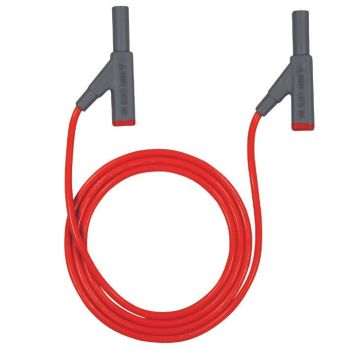
Beha 3313550 measurement cable SML 4W 2000 mm red
| Lieske Part No. | 239575 |
|---|---|
| Mfg Part No | 3313550 |
| EAN-Code | 0095969464581 |
| Manufacturer | Beha |
| Here only | 9,50 EUR
11,31 EUR incl. VAT
|
Further information for Beha 3313550 measurement cable SML 4W 2000 mm red
| General | |
| Degree of protection | CAT III/1000 V |
| Current carrying capacity | 16 A |
| Cross section | 0,8 mm² |
| Insulating material | PVC |
| Colour | Red |
Safety test lead is the central term describing the function of this lead: it serves for the safe transmission of measurement signals between the measuring device and the measurement object, with electrical insulation and mechanical robustness being the main focus. The use of PVC as insulating material ensures high electrical insulation and resistance to mechanical stress. The lead is red in colour, which is commonly used in electrical engineering to identify phase conductors or positive poles.
Measurement category CAT III/1000 V defines the maximum voltage and environmental conditions under which the lead can be safely used. CAT III refers to measurements in distribution networks, such as in electrical distribution boards or on electrical machines, where the risk of overvoltage due to atmospheric discharges or switching operations exists. The approval for 1000 V means that the lead is suitable for measurements in installations with a nominal voltage up to 1000 V.
Highly flexible describes the mechanical property of the lead, enabling high mobility and bending strength. This is particularly important for frequent use, where the lead is often bent, twisted or manoeuvred in confined spaces. The flexibility is achieved through material selection and lead construction, without impairing the electrical properties.
Current rating 16 A means that the lead is designed for a maximum current of 16 amperes. This value is crucial to ensure that the lead is not overloaded during use, thus preventing hazards such as overheating or insulation failure. The current rating depends on the cross-sectional area and the materials used, which are selected here to meet the requirements of the CAT III category.
Cross-section 0.8 mm² is the physical value determining the electrical conductivity and current-carrying capacity of the lead. A cross-section of 0.8 mm² is a standard value for test leads in electrical engineering, enabling sufficient current flow without compromising mechanical flexibility. The lead is 2000 mm long, providing sufficient reach for many measurement tasks in electrical installations.
The lead is designed for use in electrical installations, particularly in areas where safe and reliable measurement of voltage, current or power is required. It is typically connected to measuring devices such as multimeters, clamp meters or oscilloscopes to capture electrical parameters. Use in CAT III environments requires special insulation quality, which is ensured by the PVC insulation and certification.
The lead is not equipped with additional components such as connectors, cable lugs or terminal clamps. Connection is made via the exposed conductor ends, which must be fitted with appropriate connection means depending on the application. The red colour serves as visual identification and facilitates assignment in the electrical system, especially in multiple connections.
The Beha FTF000307112 is thus a specialised test lead designed for use in electrical installations with a maximum voltage of 1000 V and a measurement category of CAT III. Its highly flexible construction and current rating of 16 A make it a reliable tool for electrical specialists and technicians who need to perform precise and safe measurements. The lead is supplied in a length of 2000 mm and is suitable for use in industrial, commercial and domestic electrical installations.
PVC insulation provides high electrical insulation and mechanical stability. The insulation protects the conductor from external influences such as moisture, mechanical damage or chemical exposure. The use of PVC is widespread in electrical engineering due to its good combination of insulation properties, flexibility and durability.
Length 2000 mm provides sufficient reach for many standard measurements without the lead being excessively long and unwieldy. The length is suitable for use in distribution enclosures, machine cabins or during the installation of electrical systems. The lead is not equipped with additional connection components, so connection is made via the exposed ends.
The lead is designed for use in electrical installations, particularly in areas where safe and reliable measurement of voltage, current or power is required. It is typically connected to measuring devices such as multimeters, clamp meters or oscilloscopes to capture electrical parameters. Use in CAT III environments requires special insulation quality, which is ensured by the PVC insulation and certification.
The lead is not equipped with additional components such as connectors, cable lugs or terminal clamps. Connection is made via the exposed conductor ends, which must be fitted with appropriate connection means depending on the application. The red colour serves as visual identification and facilitates assignment in the electrical system, especially in multiple connections.
The Beha FTF000307112 is thus a specialised test lead designed for use in electrical installations with a maximum voltage of 1000 V and a measurement category of CAT III. Its highly flexible construction and current rating of 16 A make it a reliable tool for electrical specialists and technicians who need to perform precise and safe measurements. The lead is supplied in a length of 2000 mm and is suitable for use in industrial, commercial and domestic electrical installations.

This is an offer of:
79279 Vörstetten
https://industry-electronics.com
Tel. 07666/88499-0
Fax. 07666/88499-111
Diesen Artikel finden Sie unter:
industry-electronics.com/artikel/239575

Lieske Elektronik e.K.
Reutener Str. 1079279 Vörstetten
https://industry-electronics.com
Tel. 07666/88499-0
Fax. 07666/88499-111
Diesen Artikel finden Sie unter:
industry-electronics.com/artikel/239575