
Barix 2008.9091 Barionet 50
Industrial Material > Automation > Data Acquisition and Control
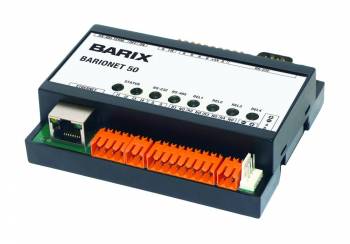
Barix 2008.9091 Barionet 50
| Lieske Part No. | 293768 |
|---|---|
| Mfg Part No | 2008.9091 |
| EAN-Code | |
| Manufacturer | Barix |
| Here only | 186,25 EUR
221,64 EUR incl. VAT
|
Further information for Barix 2008.9091 Barionet 50
| General | |
| 1-wire support | |
Applications
The I/O Device-Server is designed for applications in building automation, energy monitoring, and security technology. Typical use cases include temperature monitoring and logging, control of heating, ventilation, and air conditioning (HVAC) systems, monitoring of door or window closure contacts, and integration into PV power management systems. The combination of digital inputs, relay outputs, and serial interfaces makes the device flexible for various requirements in industrial data acquisition.
Functions and Equipment in Detail
The device features four digital contact inputs, used for detecting switching states, such as door contacts or sensors. The four relay outputs are rated for a voltage of 24 V and a current of 0.5 A, enabling control of external devices such as relays, lamps, or small motors. The serial interfaces include one RS-232 and one RS-485 port, used for communication with serial devices such as measuring instruments, sensors, or other control devices. Additionally, the device supports 1-wire technology, which is particularly used for temperature sensors from Dallas Semiconductor (e.g., DS18B20).
Technology Explained Simply
Communication takes place over IP-based networks, with the device functioning as a Modbus/TCP server to exchange data with other Modbus devices. SNMP support enables network monitoring and management, for example, for monitoring the device’s own status. The supply voltage ranges from 9 to 30 V, allowing flexible connection to various power supplies, such as 12-V or 24-V systems. The device’s programmability allows adaptation to specific requirements, with the web interface enabling configuration and control via a standard web browser.
Compatibility and Accessories
The device is compatible with various industrial protocols and can be integrated into existing networks. As suitable accessories, the IO12 (article number 2005.9048) is offered, which enables extension of the I/O functionality. The combination of both devices increases the number of available inputs and outputs and enables more complex control logic.
Mounting and Installation
Installation is typically carried out in an enclosure or a distribution box. Connection options for digital inputs, relay outputs, and serial interfaces are implemented via terminals, enabling simple and secure wiring. The network connection is made via Ethernet, with the supply voltage provided by an external power supply or an existing 12- or 24-V source. Configuration is performed via the integrated web interface, accessible through a standard web browser.
Operational Advantages
The combination of digital inputs, relay outputs, and serial interfaces in a compact device reduces the number of components required in a control system. Support for Modbus/TCP and SNMP enables easy integration into existing networks and control systems. The web-based configuration simplifies commissioning and maintenance, even remotely. The universal supply voltage range of 9 to 30 V increases flexibility during installation in various environments.

This is an offer of:
79279 Vörstetten
https://industry-electronics.com
Tel. 07666/88499-0
Fax. 07666/88499-111
Diesen Artikel finden Sie unter:
industry-electronics.com/artikel/293768

Lieske Elektronik e.K.
Reutener Str. 1079279 Vörstetten
https://industry-electronics.com
Tel. 07666/88499-0
Fax. 07666/88499-111
Diesen Artikel finden Sie unter:
industry-electronics.com/artikel/293768