
Balluff BAW0021 inductive proximity sensor
Industrial Material > Control devices / Pilot devices > Initiators, inductive / capacitive
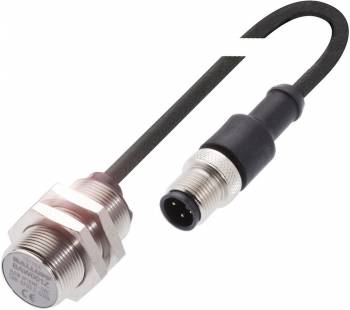
Balluff BAW0021 inductive proximity sensor
| Lieske Part No. | 950289 |
|---|---|
| Mfg Part No | BAW0021 |
| EAN-Code | |
| Manufacturer | Balluff |
| Here only | 210,17 EUR
250,10 EUR incl. VAT
|
Further information for Balluff BAW0021 inductive proximity sensor
| General | |
| Degree of protection | IP67 |
| Operating voltage | 15...30 VDC |
| Transmission range | 1...5 mm |
| Analogue output | 0...10 V |
| Output characteristic | Falling with approach |
| Cutoff frequency -3 dB | 500 Hz |
| Repeatability according to BWN | ±8 µm |
| Maximum linearity deviation | ±120 µm |
| Housing material | Brass, nickel-plated |
| Active area, material | PBT |
| Connection | cable with connector, M12x1 plug, 3-pole, 1.50 m, PUR |
| Ambient temperature | -10...70 °C |
| Approval/conformity | CE, UKCA, cULus, WEEE |
| Construction type | M18x1 |
| Built-in | Concise |
Applications
The sensor is used in applications requiring precise, non-contact measurement of distances in the range of 1 to 5 mm. Typical use cases include monitoring tool positions, detecting workpiece presence, or controlling motion sequences in automated production lines. The ability to distinguish between different material variants extends its application range in complex assembly and manufacturing processes.
Functions and Equipment in Detail
The sensor provides an absolute analog voltage signal in the range of 0 to 10 V. The output characteristic is falling, meaning the output voltage decreases as the target object approaches the sensor. Repeatability is ±8 µm according to BWN, ensuring high measurement accuracy and reproducibility. The maximum linearity deviation is ±120 µm, securing accuracy across the entire measurement range. The cutoff frequency is 500 Hz, enabling rapid response to changing positions.
Technology Explained Simply
The sensor uses inductive technology to detect metallic objects without physical contact. The active surface is made of PBT, a robust thermoplastic material suitable for industrial conditions. The housing is made of nickel-plated brass, providing corrosion resistance and mechanical strength. The M18x1 form factor allows easy integration into existing systems. The sensor is designed for flush mounting, enabling compact installation in limited space conditions.
Compatibility and Accessories
The sensor is supplied with a cable fitted with an M12x1 connector. The cable is 1.50 m long and made of PUR, ensuring high mechanical and chemical resistance. The 3-pole connection configuration allows connection to standard connectors in automation technology. The operating voltage is between 15 and 30 VDC, offering broad compatibility with common control systems. The ambient temperature range is from -10 °C to 70 °C, enabling use in various industrial environments.
Mounting and Installation
The sensor is mounted flush, with the mounting surface being flat and clean to ensure optimal functionality. Wiring is done via the M12 connector, which enables a secure and quick connection. The teach function is used to calibrate the sensor and set the desired measurement range. Adjustment is performed via an integrated switch or external control, depending on the system configuration.
Advantages in Operation
The sensor offers high reliability due to its wear-free operation and robust construction. The IP67 protection rating ensures dust- and water-tight shielding, enabling use in outdoor or humid environments. The CE, UKCA, and cULus certifications confirm compliance with European and international safety standards. WEEE compliance ensures proper disposal at the end of the device’s life cycle.

This is an offer of:
79279 Vörstetten
https://industry-electronics.com
Tel. 07666/88499-0
Fax. 07666/88499-111
Diesen Artikel finden Sie unter:
industry-electronics.com/artikel/950289

Lieske Elektronik e.K.
Reutener Str. 1079279 Vörstetten
https://industry-electronics.com
Tel. 07666/88499-0
Fax. 07666/88499-111
Diesen Artikel finden Sie unter:
industry-electronics.com/artikel/950289