
ASRock 4U8G-TURIN2/RF Rack
Computer Hardware > Server > Barebone-Servers
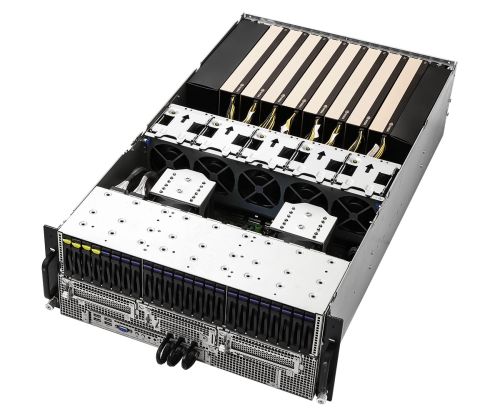
ASRock 4U8G-TURIN2/RF Rack
| Lieske Part No. | 2517153 |
|---|---|
| Mfg Part No | 4U8G-TURIN2/RF |
| EAN-Code | |
| Manufacturer | ASRock |
| Here only | 7.344,00 EUR
8.739,36 EUR incl. VAT
|
Further information for ASRock 4U8G-TURIN2/RF Rack
| General | |
| CPU socket | 2 (DP) |
| CPU socket type | Socket SP5 |
| DRAM slots | 24 |
| DRAM type | DDR5 |
| HE | 4U |
| Power supplies | 4 |
| Onboard LAN | 1Gbit/s |
| Current supply | 80-PLUS Titanium |
| Power supply configuration | 3+1 redundant |
| PCIe slots | 8 FHFL dual-slot PCIe5.0 x16, 1 FHHL PCIe5.0 x8 |
| M.2 slots | 2 |
| M.2 interface | PCIe3.0 x4 or SATA 6Gb/s |
| OCP NIC | 1 |
| OCP NIC interface | PCIe5.0 x8 |
| LAN ports | 2 |
| LAN type | RJ45 |
| LAN speed | 1 Gbit/s |
| LAN chipset | Intel® i350 |
| Remote management | IPMI |
| Drive bays | 4 hot-swap 2.5 inch NVMe (PCIe5.0 x4), 20 hot-swap 2.5 inch SATA |
| Cooling | Enhanced airflow |
| Graphics card support | 600W GPUs and Accelerator Cards |
| Onboard graphics | |
Applications
The server is designed for use in professional IT infrastructures, particularly in environments requiring high computing power, scalability, and reliability. Support for 600W graphics cards and accelerator cards makes it suitable for applications in data processing, machine learning, or high-performance computing. The 4U form factor enclosure design allows installation in standard 19-inch racks and provides sufficient space for cooling and expansion components.
Functions and Equipment in Detail
The system features 24 DIMM slots (12+12), supporting DDR5 RDIMM and RDIMM-3DS modules. This configuration enables high memory capacity and bandwidth for data-intensive applications. The memory architecture is designed for efficient use in server environments. The integrated networking functionality includes two RJ45 ports with 1 Gbit/s, based on Intel® i350 technology, ensuring stable and fast network connectivity.
Technology Explained Simply
The server is equipped with an improved airflow system, enabling reliable cooling of high-performance graphics cards with up to 600W power consumption. The cooling is dimensioned to maintain stable operating temperatures even under high loads. Power supply is provided by four 80-PLUS Titanium-certified CRPS power supplies, offering high efficiency and reliability. The 3+1 redundant power supply configuration ensures continuous power supply even if one power supply fails.
Compatibility and Accessories
The server supports eight FHFL dual-slot PCIe 5.0 x16 slots as well as one FHHL PCIe 5.0 x8 slot, enabling integration of multiple high-performance or memory expansion cards. Two M.2 slots (PCIe 3.0 x4 or SATA 6 Gb/s) offer additional storage options. An OCP NIC 3.0 (PCIe 5.0 x8) enables integration of network adapters for extended networking functions. Storage expansion includes four hot-swap 2.5-inch NVMe drives (PCIe 5.0 x4) and twenty hot-swap 2.5-inch SATA drives, enabling a flexible and scalable storage architecture.
Mounting and Installation
The server is designed for installation in standard 19-inch racks. Mounting is done via integrated rack mounting holes. The hot-swap functionality for drives allows for maintenance-friendly installation and replacement without system shutdown. The remote management function via IPMI (Intelligent Platform Management Interface) enables remote maintenance and monitoring of the system, including remote boot, status monitoring, and fault diagnosis.
Advantages in Operation
The combination of dual-socket platform, high memory capacity, expandable PCIe slots, and redundant power supplies ensures high availability and scalability. Support for AMD EPYC processors with 3D V-Cache technology enables improved performance for specific applications. Integrated networking functionality and remote management features reduce maintenance effort and enable efficient management in data centers. The cooling is designed for the load from high-performance graphics cards, increasing system stability under load.

This is an offer of:
79279 Vörstetten
https://industry-electronics.com
Tel. 07666/88499-0
Fax. 07666/88499-111
Diesen Artikel finden Sie unter:
industry-electronics.com/artikel/2517153

Lieske Elektronik e.K.
Reutener Str. 1079279 Vörstetten
https://industry-electronics.com
Tel. 07666/88499-0
Fax. 07666/88499-111
Diesen Artikel finden Sie unter:
industry-electronics.com/artikel/2517153