
ASRock 4U18N-AM5/2T Rack
Computer Hardware > Server > Barebone-Servers
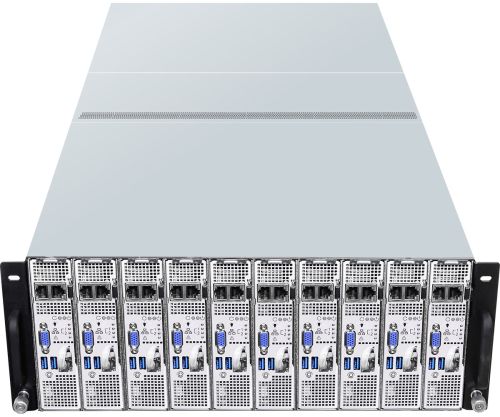
ASRock 4U18N-AM5/2T Rack
| Lieske Part No. | 2517144 |
|---|---|
| Mfg Part No | 4U18N-AM5/2T |
| EAN-Code | 4711430520599 |
| Manufacturer | ASRock |
| Here only | 16.050,00 EUR
19.099,50 EUR incl. VAT
|
Further information for ASRock 4U18N-AM5/2T Rack
| General | |
| CPU socket type | Socket AM5 |
| DRAM type | DDR5 |
| DRAM slots | 72 |
| Onboard LAN | 10Gbit/s |
| Power supplies | 4 |
| HE | 4U |
| Processor support | AMD EPYC™, AMD Ryzen™ |
| Processor performance | 65W |
| Memory per slot | 48 GB |
| SSD count | 36 x 2.5 inch NVMe |
| M.2 slots | 1 per node |
| IPMI version | 2.0 |
| Network connection | 2x RJ45 10GbE |
| Network chip | Broadcom BCM |
| Redundant power supplies | 2+2 |
| Onboard graphics | |
| Dedicated LAN | |
Applications
The server is designed for applications requiring high computing performance in a compact form factor, such as virtual machines, container orchestration, databases, or edge computing. The 18 nodes allow for flexible resource allocation, with each node being independently configurable. Support for 36x 2.5-inch NVMe SSDs provides high storage capacity and fast access times, which is particularly beneficial for I/O-intensive applications. The integrated IPMI 2.0 function with KVM and dedicated LAN enables remote maintenance and monitoring, even when the system is powered off.
Functions and Equipment in Detail
Each of the 18 nodes features two memory slots for DDR5 ECC or non-ECC UDIMM modules, with up to 48 GB of memory supported per slot. In total, 72 memory slots are available, enabling a maximum memory capacity of 3456 GB. The memory is designed for operation with DDR5 technology, offering higher speeds and efficiency compared to previous technologies. Each node includes two 2.5-inch NVMe SSDs and one M.2 slot, enabling a flexible storage architecture. The integrated graphics function is available, allowing display of system information or use of graphics-based tools without an additional graphics card.
Technology Explained Simply
The platform is based on Socket AM5, designed for AMD’s current processors. Support for 65W processors enables balanced performance with moderate power consumption. The 4U height is a standard size in server racks, allowing the server to be integrated into existing infrastructures. The power supply configuration includes four redundant power supplies in a 2+2 setup, ensuring high availability. If one of the power supplies fails, the redundant system ensures continuous power supply. The onboard LAN function provides two RJ45 ports with 10 Gbit/s, based on Broadcom BCM chips, enabling fast network connectivity. The integrated IPMI 2.0 function with KVM allows remote control and monitoring of the server via a dedicated network, independent of the operating system state.
Compatibility and Accessories
The server is compatible with AMD EPYC™ and AMD Ryzen™ processors in the 65W class. The memory slots support DDR5 ECC and non-ECC UDIMM modules, with a maximum capacity of 48 GB per slot. The memory slots are designed for use with DDR5 technology, offering higher speeds and efficiency compared to previous technologies. The integrated graphics function is available, allowing display of system information or use of graphics-based tools without an additional graphics card.
Installation and Mounting
The server is designed in 4U format, representing a standard size in server racks. Installation requires mounting the processors, memory modules, SSDs, and any additional components into the respective slots. The power supply configuration is already integrated into the chassis, with the four power supplies operating redundantly in a 2+2 setup. The IPMI function requires a network connection to utilize remote maintenance features.
Operational Advantages
The platform offers high density of processors and memory modules in a compact form factor, increasing efficiency in data centers. The redundant power supply with four power supplies in a 2+2 setup ensures high availability. The integrated IPMI 2.0 function with KVM enables remote maintenance and monitoring, even when the system is powered off. Support for DDR5 memory and 10 Gbit/s onboard LAN ensures high speeds and efficiency. The flexible storage architecture with 2x 2.5-inch NVMe SSDs and one M.2 slot per node allows individual adaptation to specific requirements.

This is an offer of:
79279 Vörstetten
https://industry-electronics.com
Tel. 07666/88499-0
Fax. 07666/88499-111
Diesen Artikel finden Sie unter:
industry-electronics.com/artikel/2517144

Lieske Elektronik e.K.
Reutener Str. 1079279 Vörstetten
https://industry-electronics.com
Tel. 07666/88499-0
Fax. 07666/88499-111
Diesen Artikel finden Sie unter:
industry-electronics.com/artikel/2517144