
ASRock 2U4G-GENOA/M3 barebone 2U single socket SP5
Computer Hardware > Server > Barebone-Servers
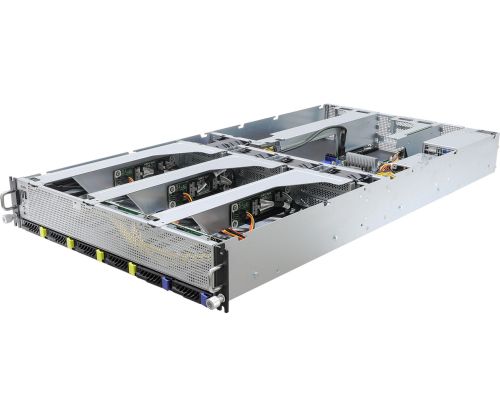
ASRock 2U4G-GENOA/M3 barebone 2U single socket SP5
| Lieske Part No. | 2487716 |
|---|---|
| Mfg Part No | 2U4G-GENOA/M3 |
| EAN-Code | 4711430520667 |
| Manufacturer | ASRock |
| Here only | 3.862,96 EUR
4.596,92 EUR incl. VAT
|
Further information for ASRock 2U4G-GENOA/M3 barebone 2U single socket SP5
| General | |
| CPU socket | 1 (UP) |
| CPU socket type | Socket SP5 |
| DRAM slots | 8 |
| DRAM type | DDR5 |
| HE | 2U |
| Power supplies | 2 |
| Onboard LAN | OCP 3.0 |
| TDP | 400 W |
| Memory max. | 512 GB |
| NVMe bays | 4 x 2.5 inch |
| SATA bays | 2 x 2.5 inch |
| M.2 slots | 2 |
| PCIe 5.0 x16 (dual-slot) | 4 |
| PCIe 5.0 x16 (single-slot) | 1 |
| PCIe 5.0 x8 | 1 |
| OCP NIC 3.0 | 1 |
| Remote management | IPMI |
| Current supply | 1+1 Hot-swap CRPS Titanium |
| Efficiency class | 80-PLUS Platinum |
| Onboard graphics | |
Applications
This server is suitable for applications in cloud infrastructure, virtual machines, databases, high-performance computing (HPC), and network or storage solutions. The 2U form factor dimensions allow for compact integration into standard 19-inch racks, enabling installation in existing server rows without additional space requirements. Support for AMD EPYC technology provides a scalable platform for future expansions and requirements.
Features and Specifications in Detail
The system includes eight DIMM slots designed for DDR5 RDIMM and RDIMM-3DS modules. The maximum supported memory capacity is 512 GB. The integrated graphics function enables basic system control and diagnostics via a monitor, which is helpful during maintenance or setup. The memory architecture supports high bandwidth and reduced latency, which is advantageous for data-intensive applications.
Technology Explained Simply
The server is equipped with four dual-slot PCIe 5.0 x16 expansion slots, one single-slot PCIe 5.0 x16 slot, and one PCIe 5.0 x8 slot. This configuration provides sufficient connectivity options for additional graphics cards, network cards, or storage expansions. PCIe 5.0 technology offers significantly higher data transfer rates compared to previous generations, increasing efficiency in data processing. The integrated OCP NIC 3.0 (PCIe 5.0 x16) enables flexible network integration and supports modern network architectures. The remote management function via IPMI (Intelligent Platform Management Interface) allows remote maintenance and monitoring of the system, even when it is not connected to the network.
Compatibility and Accessories
The server is equipped with a 1+1 hot-swap CRPS Titanium power supply, offering high efficiency in accordance with the 80-PLUS Platinum certification. The redundant power supply increases system availability and protects against failures due to power supply defects. The integrated ASPEED AST2600 platform supports IPMI functions and enables secure remote management. The interfaces include mDP (mini DisplayPort) for local display. The storage bays include four 2.5-inch NVMe drives and two 2.5-inch SATA drives, with the SATA bays configured as hot-swap bays. Additionally, two M.2 slots are available for use with fast SSDs.
Mounting and Installation
The system is designed for mounting in standard 19-inch racks and is delivered in 2U height. Installation is performed using the designated mounting points in the rack. The hot-swap functions for hard drives and the power supply simplify maintenance and expansion, as components can be replaced without shutting down the system. Remote management via IPMI reduces the need for physical presence at the server location.
Operational Advantages
The combination of AMD EPYC technology, DDR5 memory, and PCIe 5.0 slots provides high performance density and scalability. The redundant power supply and hot-swap functions increase availability and reduce downtime. The integrated remote management via IPMI enables efficient system monitoring and control, which is particularly beneficial in distributed infrastructures. Support for modern memory and network technologies ensures the system can meet future requirements.

This is an offer of:
79279 Vörstetten
https://industry-electronics.com
Tel. 07666/88499-0
Fax. 07666/88499-111
Diesen Artikel finden Sie unter:
industry-electronics.com/artikel/2487716

Lieske Elektronik e.K.
Reutener Str. 1079279 Vörstetten
https://industry-electronics.com
Tel. 07666/88499-0
Fax. 07666/88499-111
Diesen Artikel finden Sie unter:
industry-electronics.com/artikel/2487716