
ARDUINO A000067 Board Mega 2560 Rev3
Maker > Cases, Cooling and Accessories
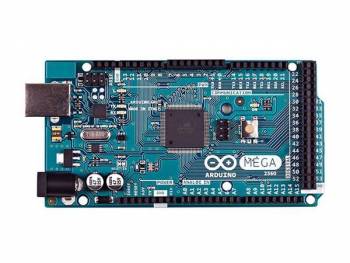
ARDUINO A000067 Board Mega 2560 Rev3
| Lieske Part No. | 128498 |
|---|---|
| Mfg Part No | A000067 |
| EAN-Code | 8058333490083 |
| Manufacturer | ARDUINO |
| Here only | 47,55 EUR
56,58 EUR incl. VAT
|
Further information for ARDUINO A000067 Board Mega 2560 Rev3
| General | |
| Microcontroller | ATmega2560 |
| Operating voltage | 5 V |
| Recommended input voltage | 7-12 V |
| Maximum input voltage | 20 V |
| Minimum input voltage | 6 V |
| Digital I/O pins | 54 |
| PWM outputs | 15 |
| Analogue inputs | 16 |
| UARTs | 4 |
| Clock frequency | 16 MHz |
| Flash memory | 256 KB |
| SRAM | 8 KB |
| EEPROM | 4 KB |
| Current per I/O pin | 20 mA |
| Current for 3.3V pin | 50 mA |
| LED_BUILTIN | 13 |
Applications
The Arduino Mega 2560 is designed for projects requiring a high number of digital and analog interfaces. Typical application fields include the control of 3D printers, robotics, industrial automation systems, or complex sensor networks. The large number of I/O pins enables simultaneous control of multiple motors, sensors, or peripheral devices. The integrated UARTs (hardware serial ports) support communication with multiple external devices via serial interfaces, which is advantageous for networked systems.
Functions and Features in Detail
The board features 54 digital input/output pins, 15 of which can be used as PWM outputs. This PWM function enables control of motors or LED brightness with variable intensity. There are 16 analog inputs for measuring voltages from sensors or other analog signal sources. The integrated USB interface allows direct connection to a computer for programming and communication. A reset button enables restarting the microcontroller. The ICSP header supports in-system programming, which is useful during development or maintenance.
Technology Explained Simply
The microcontroller ATmega2560 operates at a clock frequency of 16 MHz, providing sufficient computing power for many applications. The operating voltage is 5 V, with a recommended input voltage range of 7 to 12 V. The maximum input voltage is 20 V, with a minimum threshold of 6 V. The flash memory size is 256 KB, of which 8 KB is occupied by the bootloader. This memory is used for storing program code. The SRAM (working memory) has a capacity of 8 KB, sufficient for runtime management of variables and data. The EEPROM memory with 4 KB allows permanent storage of settings or configuration data. The maximum current draw per I/O pin is 20 mA, while the 3.3-V pin can supply up to 50 mA.
Compatibility and Accessories
The board is compatible with most shields developed for the Arduino Uno, Duemilanove, or Diecimila. This expands the number of possible extensions and application options. Using shields enables quick integration of functionalities such as WLAN, Bluetooth, display units, or additional sensors. The USB connection allows the use of a standard USB cable for programming and communication with a computer.
Mounting and Installation
Installation is done by direct connection to a computer via USB cable or by external power supply through the Power Jack. Power supply can be provided via an AC-DC power adapter or a battery. Programming is performed using the Arduino software, which communicates with the board via the USB interface. The integrated reset button allows restarting the microcontroller without physically disconnecting the power supply.
Advantages in Operation
The Arduino Mega 2560 offers a high number of I/O pins and multiple serial interfaces, enabling control of complex systems. The large flash memory size and SRAM provide sufficient resources for extensive programs. Compatibility with existing shields reduces development costs and accelerates implementation. The simple operation and widespread support from the Arduino community facilitate development and troubleshooting.

This is an offer of:
79279 Vörstetten
https://industry-electronics.com
Tel. 07666/88499-0
Fax. 07666/88499-111
Diesen Artikel finden Sie unter:
industry-electronics.com/artikel/128498

Lieske Elektronik e.K.
Reutener Str. 1079279 Vörstetten
https://industry-electronics.com
Tel. 07666/88499-0
Fax. 07666/88499-111
Diesen Artikel finden Sie unter:
industry-electronics.com/artikel/128498