
ARDUINO A000053 Board Micro
Maker > Cases, Cooling and Accessories
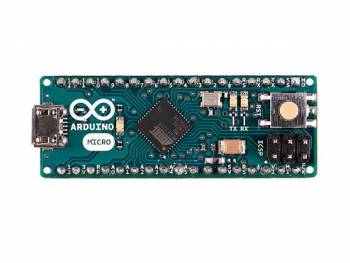
ARDUINO A000053 Board Micro
| Lieske Part No. | 128553 |
|---|---|
| Mfg Part No | A000053 |
| EAN-Code | 7630049200159 |
| Manufacturer | ARDUINO |
| Here only | 23,00 EUR
27,37 EUR incl. VAT
|
Further information for ARDUINO A000053 Board Micro
| General | |
| Operating voltage | 5 V |
| Recommended input voltage | 7-12 V |
| Maximum input voltage | 20 V |
| Minimum input voltage | 6 V |
| Digital I/O pins | 20 |
| PWM channels | 7 |
| Analogue inputs | 12 |
| Current per I/O pin | 20 mA |
| Current at 3.3V pin | 50 mA |
| Flash memory | 32 KB |
| SRAM | 2,5 KB |
| EEPROM | 1 KB |
| Clock frequency | 16 MHz |
| LED_BUILTIN | 13 |
Applications
The Arduino Micro is suitable for projects where space constraints and direct USB interaction are prioritized. Typical applications include interactive devices, prototypes for embedded systems, small robots, or devices that must communicate with a computer via USB. The combination of compact form factor and integrated USB communication makes it particularly suitable for prototypes intended to be integrated into existing devices.
Functions and Features in Detail
The board features 20 digital input/output pins, of which 7 can be used as PWM outputs and 12 as analog inputs. The PWM function enables control of motors, LEDs, or other components with variable brightness or speed. The analog inputs support voltage value acquisition, for example from sensors. A 16 MHz crystal oscillator provides the clock frequency for the microcontroller. Power supply is via a Micro-USB cable, allowing the board to be directly connected to a computer. Alternatively, it can be powered by an external voltage source of 7–12 V. The maximum input voltage is 20 V, with a minimum threshold of 6 V.
Technology Explained Simply
The ATmega32U4 microcontroller offers 32 KB of flash memory, of which 4 KB is used by the bootloader. This memory is used for storing program code. The SRAM memory amounts to 2.5 KB and is used during runtime for variables and temporary data. The EEPROM memory with 1 KB allows storage of data that remains even after power-off. The maximum current draw per I/O pin is 20 mA, while the 3.3 V pin can supply up to 50 mA. The board's operating voltage is 5 V. The integrated USB functionality allows the board to be recognized as a virtual serial-communicating device, simplifying programming and data transfer.
Compatibility and Accessories
The Arduino Micro is compatible with the Arduino development environment and can be programmed via the Micro-USB cable. It features an ICSP connector for in-system programming. The form factor similarity to the Arduino Leonardo allows the use of identical circuit diagrams and code examples. No additional USB adapters or serial converters are required for integration into projects, as the USB functionality is already integrated into the microcontroller.
Mounting and Installation
The board can be directly inserted into a breadboard, making it suitable for prototypes and experiments. Power supply is via the Micro-USB cable connected to a computer. Alternatively, it can be powered by an external voltage source of 7–12 V. Software installation is done via the Arduino IDE, available on the official website. Programming is performed via the USB cable, with the board automatically recognized as a COM port.
Advantages in Operation
The integrated USB functionality reduces required hardware and simplifies communication with the host system. The small form factor allows flexible placement in compact devices. Direct support for mouse and keyboard functions opens application possibilities in human-computer interaction. The use of the ATmega32U4 chip provides sufficient memory and processing power for many applications in microcontroller development.

This is an offer of:
79279 Vörstetten
https://industry-electronics.com
Tel. 07666/88499-0
Fax. 07666/88499-111
Diesen Artikel finden Sie unter:
industry-electronics.com/artikel/128553

Lieske Elektronik e.K.
Reutener Str. 1079279 Vörstetten
https://industry-electronics.com
Tel. 07666/88499-0
Fax. 07666/88499-111
Diesen Artikel finden Sie unter:
industry-electronics.com/artikel/128553