
AMD 100-100001404WOF CPU Ryzen 7 9700X 8-core
Computer-Components > Processors > Socket AM5
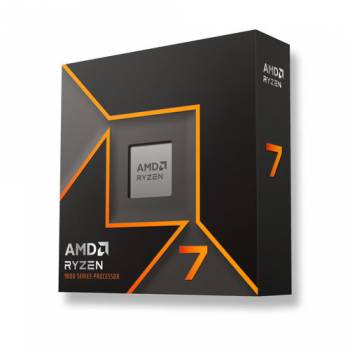
AMD 100-100001404WOF CPU Ryzen 7 9700X 8-core
| Lieske Part No. | 1215620 |
|---|---|
| Mfg Part No | 100-100001404WOF |
| EAN-Code | 0730143315593 |
| Manufacturer | AMD |
| Here only | 354,23 EUR
421,53 EUR incl. VAT
|
Further information for AMD 100-100001404WOF CPU Ryzen 7 9700X 8-core
| General | |
| Processor family | AMD Ryzen 7 |
| Socket | AM5 |
| Cores | 8 |
| Threads | 16 |
| Base frequency | 3,8 GHz |
| Turbo frequency | 5,5 GHz |
| L3 cache | 40 MB |
| TDP | 65 W |
| Lithography | 4 nm |
| Memory type | DDR5-SDRAM |
| Maximum internal memory | 192 GB |
| Memory channels | Dual-channel |
| Integrated graphics | AMD Radeon |
| Graphics base frequency | 2200 MHz |
| Supported command sets | AES, AVX, AVX 2.0, AVX-512, SSE, SSE2, SSE3, SSE4.1, SSE4.2, SSSE3 |
| USB version | 2.0/3.2 Gen 2 |
| PCIe version | 4.0 |
| PCIe lanes | x4 |
| Scope of delivery | Processor without heatsink (WOF) |
Applications
This processor is designed for use in desktop computers and is particularly suitable for systems requiring high computing performance with moderate power consumption. It is appropriate for professional work environments, home PCs, as well as gaming systems that rely on a stable and powerful CPU. Support for DDR5-SDRAM up to 5600 MHz (at 1DPC/1R and 1DPC/2R) enables fast data transfer rates, which are important for modern applications and games.
Functions and Features in Detail
The AMD Ryzen 7 9700X includes an integrated graphics processor from the AMD Radeon series, with a base frequency of 2200 MHz. This allows the processor to be used without an additional graphics card, for example in systems primarily used for office or basic home applications. The processor supports multiple instruction sets, including AES, AVX, AVX 2.0, AVX-512, SSE, SSE2, SSE3, SSE4.1, SSE4.2, and SSSE3, enhancing efficiency in cryptographic calculations, multimedia processing, and other specialized tasks. The integrated graphics supports USB 2.0 and USB 3.2 Gen 2 (also referred to as USB 3.1 Gen 2), enabling connectivity to modern peripheral devices.
Technology Explained Simply
The processor is based on 4-nm lithography, enabling high transistor density and thus more efficient performance with lower power consumption. The TDP (Thermal Design Power) is 65 watts, considered moderate and ensuring efficient cooling. The L3 cache has a capacity of 40 MB, increasing access speed to frequently used data and improving overall system performance. Support for DDR5-SDRAM with up to 192 GB maximum internal memory capacity allows for large RAM usage, which is required for demanding applications.
Compatibility and Accessories
The processor is designed for motherboards with the AM5 socket and requires a compatible motherboard platform. It supports PCIe 4.0 with a bandwidth of x4, enabling connection to fast storage and graphics cards. The CPU is available as a boxed model, meaning it is delivered in packaging that includes the processor itself. Therefore, the use of a separate cooling module is required to maintain operating temperature within acceptable limits.
Installation and Mounting
Installation involves inserting the processor into the AM5 socket on the motherboard, ensuring correct alignment of the processor and secure locking of the socket. Mounting does not require additional tools, but the use of an appropriate cooling module is necessary to avoid thermal stress. The CPU is designed for use in desktop systems and requires a compatible motherboard platform.
Advantages in Operation
The AMD Ryzen 7 9700X offers a balanced combination of performance and energy efficiency. The 8 cores and 16 threads enable efficient multitasking, while the integrated graphics allow usage without an additional graphics card. Support for DDR5-SDRAM and PCIe 4.0 ensures fast data transfer, and the 4-nm lithography results in low heat generation. The TDP of 65 watts is sufficient for operation in standard PC systems without requiring an oversized heatsink. The CPU is therefore suitable for a wide range of applications, from office applications to high-performance gaming systems.

This is an offer of:
79279 Vörstetten
https://industry-electronics.com
Tel. 07666/88499-0
Fax. 07666/88499-111
Diesen Artikel finden Sie unter:
industry-electronics.com/artikel/1215620

Lieske Elektronik e.K.
Reutener Str. 1079279 Vörstetten
https://industry-electronics.com
Tel. 07666/88499-0
Fax. 07666/88499-111
Diesen Artikel finden Sie unter:
industry-electronics.com/artikel/1215620