
AMD 100-100000263BOX CHIP Ryzen 7 5700G
Computer-Components > Processors > Socket AM4
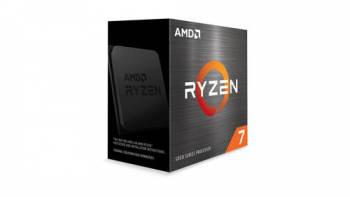
AMD 100-100000263BOX CHIP Ryzen 7 5700G
| Lieske Part No. | 1202905 |
|---|---|
| Mfg Part No | 100-100000263BOX |
| EAN-Code | 0730143313377 |
| Manufacturer | AMD |
| Here only | 203,00 EUR
241,57 EUR incl. VAT
|
Further information for AMD 100-100000263BOX CHIP Ryzen 7 5700G
| General | |
| Processor family | AMD Ryzen 7 |
| Socket | AM4 |
| Cores | 8 |
| Threads | 16 |
| Base frequency | 3,8 GHz |
| Turbo frequency | 4,6 GHz |
| Manufacturing technology | 7 nm |
| TDP | 65 W |
| Memory type | DDR4-SDRAM |
| Memory clock rate | 3200 MHz |
| Memory channels | Dual-channel |
| Integrated graphics | AMD Radeon Graphics |
| Graphics base frequency | 2000 MHz |
| Market segment | Desktop |
| Scope of delivery | AMD Wraith Stealth Cooler |
Processor architecture and performance
The Ryzen 7 5700G is an 8-core processor with 16 threads, enabling high parallel processing capability. The base frequency is 3.8 GHz, with the clock speed increasing up to 4.6 GHz in Turbo mode to provide additional performance during short load peaks. The Ryzen 7 processor family represents a balanced combination of performance and energy efficiency, with the 7-nm fabrication technology enabling lower heat generation and higher efficiency. The integrated graphics unit, referred to as AMD Radeon Graphics, has a base frequency of 2000 MHz and is suitable for desktop applications, office software, and light gaming scenarios.
Memory support and system compatibility
The processor supports DDR4-SDRAM memory in a dual-channel configuration. The maximum memory clock rate supported by the processor is 3200 MHz, enabling fast data transfer between RAM and CPU. Compatibility with socket AM4 means the processor can be used in motherboards supporting this socket, providing a wide selection of motherboards for desktop systems. The market segment is clearly targeted at desktop systems, making the processor suitable for home and office PCs, as well as entry-level and mid-range systems.
Thermal performance and power consumption
The processor has a thermal design power (TDP) of 65 watts, indicating moderate power consumption and low heat generation during operation. This allows the use of standard coolers, such as the AMD Wraith Stealth Cooler, which is included in the package. The combination of low TDP and efficient cooling ensures stable operation even under load, without requiring additional cooling measures.
t
Integrated graphics and application areas
The integrated AMD Radeon Graphics unit has a base frequency of 2000 MHz and is suitable for desktop applications, web browsers, office software, and light gaming. The graphics unit is designed for use without an additional graphics card, making the processor particularly attractive for systems without a dedicated graphics card. The integrated graphics supports video output through standard video connectors, making it ideal for entry-level PCs, multimedia systems, and general-purpose computers.
Scope of delivery and installation
The processor is delivered in a boxed package, including the AMD Wraith Stealth Cooler. This heatsink is designed for operation with the Ryzen 7 5700G and enables efficient heat dissipation. Installation is performed via socket AM4, with the processor installed on motherboards featuring this socket.
Advantages in operation
The Ryzen 7 5700G offers balanced performance for desktop use, with good multitasking capability and integrated graphics that eliminate the need for a separate graphics card. The 7-nm fabrication technology ensures efficient power usage and low heat generation, making operation in standard PCs stable and reliable. Compatibility with socket AM4 and DDR4-SDRAM enables a wide selection of motherboards and memory modules, providing flexibility in system planning.

This is an offer of:
79279 Vörstetten
https://industry-electronics.com
Tel. 07666/88499-0
Fax. 07666/88499-111
Diesen Artikel finden Sie unter:
industry-electronics.com/artikel/1202905

Lieske Elektronik e.K.
Reutener Str. 1079279 Vörstetten
https://industry-electronics.com
Tel. 07666/88499-0
Fax. 07666/88499-111
Diesen Artikel finden Sie unter:
industry-electronics.com/artikel/1202905