
AMD 100-100000063WOF CHIP Ryzen 7 5800X
Computer-Components > Processors > Socket AM4
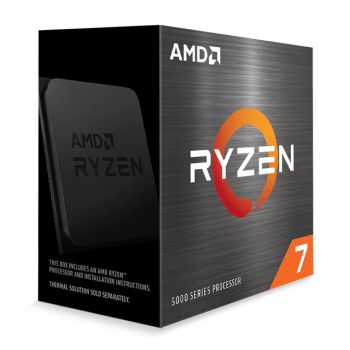
AMD 100-100000063WOF CHIP Ryzen 7 5800X
| Lieske Part No. | 1519769 |
|---|---|
| Mfg Part No | 100-100000063WOF |
| EAN-Code | 0730143312714 |
| Manufacturer | AMD |
| Here only | 178,36 EUR
212,25 EUR incl. VAT
|
Further information for AMD 100-100000063WOF CHIP Ryzen 7 5800X
| General | |
| Processor family | AMD Ryzen™ 7 |
| Socket | AM4 |
| Cores | 8 |
| Threads | 16 |
| Base frequency | 3,8 GHz |
| Turbo frequency | 4,7 GHz |
| L3 cache | 36 MB |
| TDP | 105 W |
| Memory type | DDR4-SDRAM |
| Memory clock rate | 3200 MHz |
| Lithography | 7 nm |
| Market segment | Desktop |
| Scope of delivery | Processor without heatsink |
Applications
The Ryzen 7 5800X is primarily designed for use in desktop computers. It is suitable for users requiring high computing power, such as video editing, 3D modeling, programming, or running multiple applications simultaneously. The combination of eight cores and 16 threads enables parallel processing of multiple tasks, enhancing system responsiveness. Support for DDR4-SDRAM up to 3200 MHz clock speed ensures smooth interaction with RAM, especially in data-intensive applications.
Features and Specifications in Detail
The processor includes an integrated memory controller, enabling direct communication with DDR4-SDRAM. The maximum memory clock speed of 3200 MHz supports fast data access and reduces latency. The CPU features a 36 MB L3 cache, serving as shared memory for all cores and improving efficiency for frequently accessed data. The TDP (Thermal Design Power) is 105 W, indicating maximum heat output under load and being relevant for selecting an appropriate cooling module.
Technology Explained Simply
7-nm lithography is a manufacturing technique that arranges transistors on the CPU silicon wafer extremely small and densely. This increases performance per unit area while reducing power consumption and heat generation. The 8 cores allow for simultaneous execution of eight processes, with each core capable of handling up to two threads (Hyper-Threading), resulting in a total of 16 threads. This is particularly beneficial for applications that work in parallel, such as video rendering or virtualization. The 36 MB L3 cache acts as a fast intermediate memory for frequently used data, reducing the need for the CPU to access the slower RAM.
Compatibility and Accessories
The processor is designed for motherboards with socket AM4, offered by AMD and other manufacturers for Ryzen systems. Compatibility with DDR4-SDRAM up to 3200 MHz requires a corresponding motherboard and RAM module. As an alternative or successor, the Ryzen 7 5800XT is mentioned, which features a similar architecture but offers a higher turbo frequency of 4.8 GHz. For operation, a suitable CPU cooler is required to ensure adequate heat dissipation at the TDP of 105 W.
Installation and Mounting
Installation involves placing the processor into the AM4 socket on the motherboard. Correct alignment (usually indicated by a notch or marking) must be observed. After insertion, the socket is closed, and the CPU must not be forced into place. The processor is delivered without a cooler, so a compatible CPU cooler with thermal paste must be installed before the system is powered on. Mounting is typically tool-free, but using an appropriate cooling module is essential to ensure operational safety.
Advantages in Operation
The Ryzen 7 5800X offers a balanced combination of performance and energy efficiency. The 8 cores and 16 threads enable high parallel processing, positively impacting system responsiveness. Support for DDR4-SDRAM up to 3200 MHz clock speed ensures fast data access. The 7-nm technology reduces power consumption and heat generation, extending the component's lifespan. The TDP of 105 W is typical for a high-end processor and requires an appropriate cooling solution to maintain operating temperatures within acceptable limits. The CPU is designed for desktop systems and provides a stable platform for demanding applications.

This is an offer of:
79279 Vörstetten
https://industry-electronics.com
Tel. 07666/88499-0
Fax. 07666/88499-111
Diesen Artikel finden Sie unter:
industry-electronics.com/artikel/1519769

Lieske Elektronik e.K.
Reutener Str. 1079279 Vörstetten
https://industry-electronics.com
Tel. 07666/88499-0
Fax. 07666/88499-111
Diesen Artikel finden Sie unter:
industry-electronics.com/artikel/1519769