
Allnet RS308-D4WP Rock Pi S 512 MB with WiFi and Bluetooth
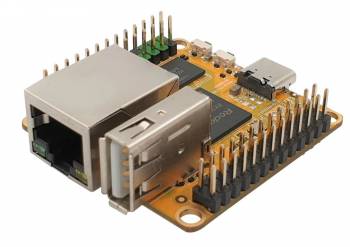
Allnet RS308-D4WP Rock Pi S 512 MB with WiFi and Bluetooth
| Lieske Part No. | 1786700 |
|---|---|
| Mfg Part No | RS308-D4WP |
| EAN-Code | 4038816091031 |
| Manufacturer | Allnet |
| Here only | 29,80 EUR
35,46 EUR incl. VAT
|
Further information for Allnet RS308-D4WP Rock Pi S 512 MB with WiFi and Bluetooth
| General | |
| Processor | Rockchip RK3308 Quad A35 64bit |
| RAM | 512 MB |
| VAD | Integrated |
| USB ports | USB 2.0 OTG (Type C) + USB 2.0 HOST (Type A) |
| Ethernet | RJ45 100MB |
| WLAN | 802.11 b/g/n |
| Bluetooth | 4.0 (rtl8723bs) |
| GPIO header | 26-pin |
| Audio connector strip | 26-pin with I2S, PCM, TDM, PDM, SPDIF, HDMI ARC |
| Operating systems | Debian, Buildroot |
| PoE | optional, additional HAT required |
Applications
The Rock Pi S is suitable for a wide range of applications in industrial automation, Smart Home, surveillance systems, and embedded systems. Due to its integrated WLAN and Bluetooth functions, as well as GPIO and audio interfaces, it is particularly suited for projects involving sensor integration, audio processing, or network control. Support for Debian and Buildroot enables flexible software development and customization.
Functions and Features in Detail
The computer features a USB 2.0 OTG port (Type C) and a USB 2.0 Host port (Type A), allowing external devices such as flash drives, keyboards, or mice to be connected. The network interface is an RJ45 port with 100 MBit/s Ethernet. The WLAN function is based on the rtl8723bs chip and supports the standards 802.11 b/g/n. Bluetooth 4.0 is also integrated, enabling wireless communication with compatible devices. An external antenna connector is available to improve range and signal quality.
Technology Explained Simply
The Rockchip RK3308 processor offers four ARM Cortex-A35 cores, ensuring energy-efficient and powerful performance. The integrated VAD function detects voice activity and can optimize audio signal processing, for example in voice assistants or surveillance systems. The 26-pin GPIO header allows connection to sensors, relays, or other digital components. The 26-pin audio header supports various audio formats such as I2S, PCM, TDM, PDM, SPDIF, and HDMI ARC, enabling flexible use in audio and voice applications. Operating systems Debian and Buildroot have been successfully tested, confirming compatibility with common Linux environments.
Compatibility and Accessories
Various accessories are available to extend functionality, including microSD cards in different capacities (16 GB, 32 GB, 64 GB, 128 GB) from brands such as EMTEC and Kodak. These serve as storage media for the operating system and applications. MicroSD extension cables and adapters are also available to increase flexibility in storage connectivity.
Mounting and Installation
The Rock Pi S is designed as a compact board and can be mounted in small housings or on prototype boards. The GPIO and audio headers allow easy connection to external components. Installation involves providing an operating system on a microSD card, with Debian and Buildroot being tested systems. Network and USB connections allow direct connection to a computer or network. For PoE applications, the additional HAT module must be physically plugged onto the board and configured.
Advantages in Operation
The Rock Pi S offers an excellent combination of performance, energy efficiency, and functionality in a very small form factor. The integrated WLAN and Bluetooth functions, along with GPIO and audio interfaces, enable a wide range of application possibilities. Compatibility with common Linux distributions such as Debian and Buildroot simplifies application development and maintenance.

This is an offer of:
79279 Vörstetten
https://industry-electronics.com
Tel. 07666/88499-0
Fax. 07666/88499-111
Diesen Artikel finden Sie unter:
industry-electronics.com/artikel/1786700

Lieske Elektronik e.K.
Reutener Str. 1079279 Vörstetten
https://industry-electronics.com
Tel. 07666/88499-0
Fax. 07666/88499-111
Diesen Artikel finden Sie unter:
industry-electronics.com/artikel/1786700