
Allnet ANT-868-12.5dbi-Yagi LoRA Antenna 12.5 dBi
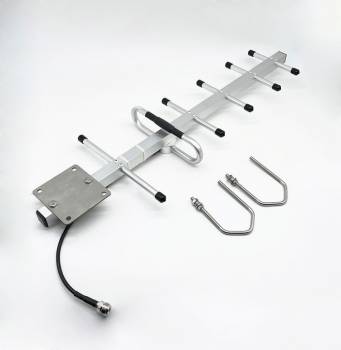
Allnet ANT-868-12.5dbi-Yagi LoRA Antenna 12.5 dBi
| Lieske Part No. | 1929121 |
|---|---|
| Mfg Part No | ANT-868-12.5dbi-Yagi |
| EAN-Code | 4038816208613 |
| Manufacturer | Allnet |
| Here only | 55,20 EUR
65,69 EUR incl. VAT
|
Further information for Allnet ANT-868-12.5dbi-Yagi LoRA Antenna 12.5 dBi
| General | |
| Frequency range | 806-896 MHz |
| Gain | 12.5 dBi |
| H-Beamwidth | 42 ° |
| E-Beamwidth | 39 ° |
| Impedance | 50 Ohm |
| VSWR | <=1.4 |
| Connection | N-Type Female |
| F/B ratio | >17 dB |
| Max. power | 100 Watt |
| Radome material | Fiberglass |
| Radome diameter | 20 mm |
| Maximum wind load | 200 km/h |
| Operation temperature | -45 to +75 °C |
| Storage temperature | -50 to +75 °C |
| Mounting method | Mast mounting |
| Polarization | Vertical / Horizontal |
Applications include wireless communication in industrial and IoT environments, particularly in networks operating on the 868 MHz band. The antenna is suitable for outdoor use, as it features a robust construction and protection against environmental influences such as wind and temperature fluctuations. The maximum wind load is 200 km/h, ensuring operational capability even in strong winds. The operating temperature ranges from -45 °C to +75 °C, enabling use in extreme climatic conditions.
Functions and equipment in detail include an N-type connector (female) as the interface, compatible with standard antenna cables. The impedance is 50 Ohm, and the VSWR (Voltage Standing Wave Ratio) is ≤1.4, ensuring efficient energy transfer and low reflections. The beamwidths are 42° horizontally (H-beamwidth) and 39° vertically (E-beamwidth), with values applying to vertical polarization. The antenna is equipped with a fiberglass radome (diameter 20 mm) that protects the elements and enhances mechanical stability. The color is white/grey.
Technology explained simply shows that the antenna’s directional characteristics enable targeted signal transmission. The high gain (12.5 dBi) results in improved range and signal quality, especially in point-to-point connections. The F/B ratio (>17 dB) ensures that signals from behind (e.g., from other transmitters) are only minimally received, enhancing signal purity. The maximum power handling is 100 W, which is sufficient for most IoT and LoRA applications.
Compatibility and accessories include various antenna cables specifically designed for connection to devices with R-SMA or N-type connectors. Available cables include models with lengths from 150 cm to 7 m, such as LMR-195 cables with N-type connectors or RG-8 cables. A lightning protector for the frequency range 2.4–5 GHz is also available, although not specifically for the 868 MHz band. The antenna is designed for mast mounting, and the delivery includes the antenna and mounting accessories.
Mounting and installation is carried out on a mast, with the antenna secured using the included mounting accessories. Dimensions are 941 mm (length) × 202 mm (width) × 55 mm (height), and the total weight including mounting accessories is 0.9 kg. Installation requires no special tools beyond standard mounting equipment. The antenna is designed for permanent outdoor installation.
Operational advantages include high signal quality, low interference from other systems, and robustness against environmental influences. The antenna is particularly suitable for applications requiring targeted, long-range communication, such as in industry, sensor networks, or infrastructure monitoring. Use in the Helium network or LoRA systems benefits from the high gain and directional characteristics.
The antenna is designed for use in LoRA-IoT systems, with technical specifications such as frequency range, gain, impedance, and VSWR tailored to the requirements of these technologies. The protection rating is not explicitly stated, but the information on wind load and temperature range indicates suitability for outdoor applications. The polarization can be vertical or horizontal, with technical data applying to vertical polarization.

This is an offer of:
79279 Vörstetten
https://industry-electronics.com
Tel. 07666/88499-0
Fax. 07666/88499-111
Diesen Artikel finden Sie unter:
industry-electronics.com/artikel/1929121

Lieske Elektronik e.K.
Reutener Str. 1079279 Vörstetten
https://industry-electronics.com
Tel. 07666/88499-0
Fax. 07666/88499-111
Diesen Artikel finden Sie unter:
industry-electronics.com/artikel/1929121