
Allnet ALL3542 8-channel Contact Input Pulse Extension
Installation > Home Automation > Home Automation - Others
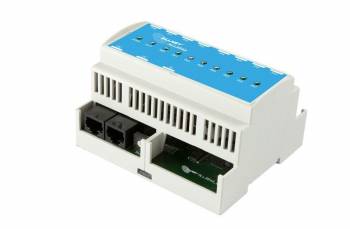
Allnet ALL3542 8-channel Contact Input Pulse Extension
| Lieske Part No. | 623606 |
|---|---|
| Mfg Part No | ALL3542 |
| EAN-Code | 4038816019295 |
| Manufacturer | Allnet |
| Here only | 100,43 EUR
119,51 EUR incl. VAT
|
Further information for Allnet ALL3542 8-channel Contact Input Pulse Extension
| General | |
| Number of inputs | 8 |
| Contact type | Dry contact |
| Signal evaluation | open = 1, closed = 0 |
| Mounting method | DIN rail mounting |
| Width of module | 107 mm |
| Compatibility | ALL3418v2, ALL3500, ALL4500, ALL5000 |
| Incompatibility | ALL3000, ALL4000, ALL4001 |
| Pulse extension | |
Applications
This module is used in professional home and building automation systems where it is necessary to monitor multiple binary sensor inputs via a central control unit. Typical applications include monitoring access doors, windows, roller shutters, or other mechanical switches that operate via potential-free contact relays. The pulse extension ensures that brief state changes are not lost, which is especially important with mechanical switches that may exhibit contact bounce or with weak signals.
Functions and Equipment in Detail
The ALL3542 features eight independent inputs, each capable of controlling a potential-free contact. The signals are digitized and transmitted to the higher-level central unit. Evaluation follows the resting current loop principle, where an open contact is rated as '1' and a closed contact as '0'. This logic is standard in many security systems and building automation solutions. The pulse extension ensures that short signals, such as those generated by quickly opening a door, are not overlooked but are marked as active for a defined period.
Technology Explained Simply
The module operates as a digital input module that does not require its own power supply, instead being powered via the central unit. It is designed for mounting on a DIN rail, with a total width of 107 mm. The inputs are designed for potential-free contacts, meaning they do not carry their own voltage but only transmit the state (open/closed) of an external switch. The pulse extension is an integrated function that ensures even short signals caused by mechanical irregularities are detected in the system.
Compatibility and Accessories
The module is specifically designed for use with the MSR central units ALL3418v2, ALL3500, ALL4500, and ALL5000. It can be combined with other components of the Allnet MSR ecosystem, such as the central unit ALL3419, which also features WLAN and sensor ports, or the central unit ALL5000v2 with 16 sensor ports. Additionally, switch sockets such as the ALL3073V3WLAN or ALL3075v4 are available and can be integrated into the system. The software solutions IP-Symcon Basic (ALL3088) and IP-Symcon Prof. (ALL3089) support control and visualization of connected devices.
Mounting and Installation
Mounting is done on a standard DIN rail, with the module width being 107 mm. The connections for the contacts are implemented via terminals designed for connecting to external sensors or switches. Connection to the central unit is made via a network cable, with communication occurring over the IP protocol. Installation does not require special tools, but correct wiring of the sensors and a stable network connection to the central unit are necessary.
Advantages in Operation
The module enables reliable detection of binary states in building automation systems. The pulse extension ensures high signal quality, even with mechanically imprecise switches. DIN rail mounting simplifies integration into existing electrical installations. Compatibility with multiple central units in the Allnet MSR portfolio offers flexibility in system selection. The use of IP-based protocols enables centralized control and monitoring over the network, simplifying maintenance and diagnostics.

This is an offer of:
79279 Vörstetten
https://industry-electronics.com
Tel. 07666/88499-0
Fax. 07666/88499-111
Diesen Artikel finden Sie unter:
industry-electronics.com/artikel/623606

Lieske Elektronik e.K.
Reutener Str. 1079279 Vörstetten
https://industry-electronics.com
Tel. 07666/88499-0
Fax. 07666/88499-111
Diesen Artikel finden Sie unter:
industry-electronics.com/artikel/623606