
Allnet ALL3500 MSR Central WLAN
Installation > Home Automation > Home Automation - Others
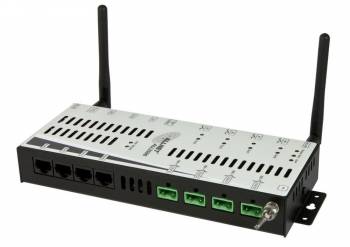
Allnet ALL3500 MSR Central WLAN
| Lieske Part No. | 361425 |
|---|---|
| Mfg Part No | ALL3500 |
| EAN-Code | 4038816035004 |
| Manufacturer | Allnet |
| Here only | 275,94 EUR
328,37 EUR incl. VAT
|
Further information for Allnet ALL3500 MSR Central WLAN
| General | |
| Platform | Embedded-Linux |
| Architecture | MIPS or ARM |
| Number of RJ45 ports | 4 |
| Number of relay outputs | 4 |
| Number of contact inputs | 4 |
| Network connection | Ethernet and WLAN |
| Data protocols | JSON, MQTT, SNMP |
| Control interface | web interface (HTTP/HTTPS), smartphone |
| Expandability | i2C-sensor ports |
| Compatibility | ALLNET sensors and actuators |
Applications
The ALL3500v2 is suitable for various application scenarios in building automation. These include HACCP-compliant temperature monitoring in critical environments such as refrigerated rooms or kitchens, room climate control by monitoring temperature and humidity for demand-based control of heating or humidifiers, and security management by detecting gas odour, smoke, or water ingress with subsequent alarm triggering. Additionally, automated garden irrigation controlled by time and moisture values, as well as energy consumption optimisation based on data from external power meters (e.g. ALL4590/4490), are typical use cases.
Functions and Equipment in Detail
The central unit features four RJ45 ports that can be used to connect sensor modules. These ports enable the integration of various sensors, such as temperature, humidity, or smoke detectors, as well as actuators for controlling loads. Additionally, four relay outputs are available for switching electrical loads, and four contact inputs are provided for connecting pushbuttons or switches. Control can be performed manually, time-based, or dynamically, depending on the measured values.
Technology Explained Simply
The ALL3500v2 is based on an Embedded-Linux platform built on MIPS or ARM architecture. This platform ensures a stable and reliable operating environment that integrates seamlessly into existing networks. The central unit is equipped with Ethernet and built-in WLAN, enabling flexible network connectivity. Via an IP address in a TCP/IP network, measurement data can be retrieved and processed in a web browser. Additionally, automated notifications and reports can be received via email. Data connectivity is supported through various protocols: JSON, MQTT, and SNMP are supported, enabling integration into IoT environments or cloud-based applications. MQTT support allows data transmission to the cloud and communication with other IoT devices.
Compatibility and Accessories
The ALL3500v2 is expandable and compatible with a wide range of ALLNET sensors and actuators. These include, for example, the MSR Sensor ALL4452 (PIR motion detector), the temperature sensor ALL4406, the smoke detector gas sensor ALL4454, the HUT temperature sensor ALL4006, the voltage monitor ALL4024, the noise sensor ALL4056, the liquid level monitor ALL3037, the contact counter ALL4425, the switchable socket ALL3073V3WLAN, the magnetic window/door contact ALL3041, the switching output ALL3003, the COM port RJ45 adapter, the shock sensor ALL4054, the PIR motion detector ALL3051, the port multiplexer ALL4404, the network NTP GPS server ALL-NTP-101, and the power meter central unit ALL3696. The central unit is also expandable with i2C sensor ports, enabling integration of additional sensors.
Installation and Mounting
The ALL3500v2 is designed for space-saving installation and can be mounted in standard network enclosures or at suitable mounting points within the building. Integration is achieved via Ethernet or WLAN, eliminating the need for additional cabling. Configuration is performed via the web interface, accessible through a web browser. The central unit requires no special tools for installation, as connections are standardised.
Operational Advantages
The central unit offers high flexibility and scalability, as it can be combined with various sensors and actuators. The integrated WLAN function enables wireless integration into existing networks, simplifying installation. Support for multiple data protocols (JSON, MQTT, SNMP) facilitates integration into existing IT infrastructures. The web interface and mobile control via smartphone ensure intuitive operation. The central unit is suitable for private and commercial applications and provides an economical solution for building automation.

This is an offer of:
79279 Vörstetten
https://industry-electronics.com
Tel. 07666/88499-0
Fax. 07666/88499-111
Diesen Artikel finden Sie unter:
industry-electronics.com/artikel/361425

Lieske Elektronik e.K.
Reutener Str. 1079279 Vörstetten
https://industry-electronics.com
Tel. 07666/88499-0
Fax. 07666/88499-111
Diesen Artikel finden Sie unter:
industry-electronics.com/artikel/361425