
Allnet ALL0178v2 USB RS232 Adapter FTDI
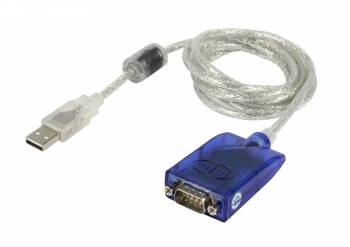
Allnet ALL0178v2 USB RS232 Adapter FTDI
| Lieske Part No. | 641521 |
|---|---|
| Mfg Part No | ALL0178v2 |
| EAN-Code | 4038816104373 |
| Manufacturer | Allnet |
| Here only | 12,43 EUR
14,79 EUR incl. VAT
|
Further information for Allnet ALL0178v2 USB RS232 Adapter FTDI
| General | |
| Adapter cable type | USB to RS-232 adapter cable |
| Connection side A | USB Type A connector |
| Connection side B | V.24 RS232 connector (9-pin) |
| Reception buffer | 128 Byte |
| Transmit buffer | 256 Byte |
| Chipset | FTDI FT232R |
| Driver | VCP and D2xx |
| LED indicators | transmit and receive LED |
| UART interface | 7 or 8 data bits, 1 or 2 stop bits |
| USB standard | USB 2.0 Full Speed |
| Host controller compatibility | UHCI/OHCI/EHCI |
| Operation temperature | -40 to 85 °C |
| Operating humidity | 10 to 90 % (non-condensing) |
| Cable length | 1,5 m |
| Level converter | Integrated, +1.8V to +5V |
| Operating systems | Windows, macOS, Linux, Android |
Applications
This adapter cable is suitable for connecting serial peripheral devices such as industrial controls, measuring instruments, printers, modems, or other devices communicating via an RS-232 interface. It is commonly used in environments where older devices need to be connected to modern computers or embedded systems. Support for operating systems such as Windows, macOS, Linux, and Android expands its usability across various industries, including automation, telecommunications, and maintenance.
Functions and Features in Detail
The cable features a USB Type A connector on one end and a 9-pin D-Sub connector (V.24 RS232) on the other. Data transmission speeds range from 300 baud to 3 Mbaud, enabling broad compatibility with various devices. The integrated FTDI FT232R chip provides a 128-byte receive buffer and a 256-byte transmit buffer, ensuring efficient data transfer even under high loads. The UART interface supports 7 or 8 data bits, 1 or 2 stop bits, allowing configuration for different serial protocols.
Technology Explained Simply
The FT232R chip handles all USB protocol processing and converts USB signals into serial data. No special firmware programming is required. The integrated 1024-bit EEPROM allows storage of device descriptions and CBUS I/O configurations. Power is supplied via the USB port (bus-powered), eliminating the need for an external power source. The built-in voltage conversion (level shifter) enables adaptation to logic levels between +1.8 V and +5 V. The operating temperature ranges from -40 °C to +85 °C, allowing use in industrial environments with extreme temperatures.
Compatibility and Accessories
The cable is compatible with USB 2.0 Full Speed and supports UHCI/OHCI/EHCI host controllers. The driver environment includes FTDI’s Virtual Com Port (VCP) and Direct (D2xx) drivers, available for various operating systems, including Windows 98 to Windows 10, Windows CE, macOS, Linux, and Android. Drivers can be downloaded from the official FTDI website. Integrated transmit and receive LEDs provide visual indication of data transmission and facilitate troubleshooting.
Installation and Mounting
Installation is performed by simply connecting the USB connector to a USB port on the host system and the RS232 connector to the serial device. Drivers are installed automatically if available on the system; otherwise, they can be installed manually from the FTDI website. The cable length is 1.5 meters, providing sufficient reach for most applications. The housing is made of plastic and is designed for indoor use.
Operational Advantages
The combination of high transmission speed, large buffer, and compatible drivers ensures reliable and stable data transfer. The integrated LED indicators simplify diagnosis of connection issues. Support for a wide range of operating systems increases deployment flexibility. The cable is suitable for use in environments with high temperature and humidity loads, with operating humidity between 10 % and 90 % (non-condensing).

This is an offer of:
79279 Vörstetten
https://industry-electronics.com
Tel. 07666/88499-0
Fax. 07666/88499-111
Diesen Artikel finden Sie unter:
industry-electronics.com/artikel/641521

Lieske Elektronik e.K.
Reutener Str. 1079279 Vörstetten
https://industry-electronics.com
Tel. 07666/88499-0
Fax. 07666/88499-111
Diesen Artikel finden Sie unter:
industry-electronics.com/artikel/641521