
Allnet ALL-D-3 4duino Board Nano v3
Maker > Sensors, Modules and Expansion Boards
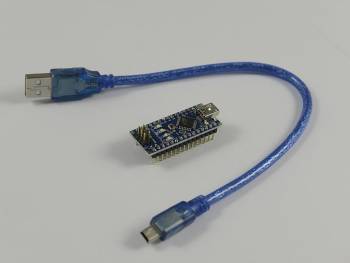
Allnet ALL-D-3 4duino Board Nano v3
| Lieske Part No. | 634755 |
|---|---|
| Mfg Part No | ALL-D-3 (A4) (A4) |
| EAN-Code | 4038816025210 |
| Manufacturer | Allnet |
| Here only | 10,80 EUR
12,85 EUR incl. VAT
|
Further information for Allnet ALL-D-3 4duino Board Nano v3
| General | |
| Compatibility | Arduino™ Nano v3 |
| Microcontroller | ATMEGA328P |
| Number of PWM pins | 6 |
| Number of analogue inputs | 6 |
| Voltage control | 5 V |
| SRAM | 2 KB |
| EEPROM | 1 KB |
| Scope of delivery | Without cable |
| USB interface | |
Applications
The 4duino Board Nano v3 is suitable for a wide range of applications in microcontroller development, including control of sensors, actuators, LED matrices, relays, and other electronic components. It is frequently used in automation projects, prototyping, IoT applications, and within the Maker community. Its compact design makes it especially suitable for built-in solutions in devices or for mobile applications.
Functions and Features in Detail
The board features the ATMEGA328P microcontroller, which includes 20 digital I/O pins (6 of which support PWM functionality) and 6 analog inputs. These resources enable control of various peripheral devices and analog signal acquisition. The integrated USB interface allows direct connection to a computer, enabling programming, debugging, and data transfer without additional hardware. Power supply is provided via USB or an external voltage source in the range of 7 to 12 V DC, with internal voltage regulation down to 5 V.
Technology Explained Simply
The ATMEGA328P is an 8-bit microcontroller with 32 KB flash memory, 2 KB SRAM, and 1 KB EEPROM. These memory capacities are sufficient for most applications in microcontroller control. PWM functions on the digital pins allow control of motors, LEDs, or other components with variable brightness or speed. The analog input function enables voltage measurement in the range of 0 to 5 V, which can be used for temperature or light sensors, for example. The USB interface is implemented via an integrated CH340G controller, enabling communication between the microcontroller and the computer over USB.
Compatibility and Accessories
The board is compatible with the Arduino™ Nano v3 platform, meaning it can be programmed using the Arduino IDE and uses the same libraries and sketches. It is thus part of an extensive ecosystem of software, hardware, and community resources. Standard USB cables can be used, provided they support the Mini-B connector.
Mounting and Installation
Installation is performed by directly connecting the board via USB to a computer. Programming can be done using the Arduino IDE or other development environments that support the Arduino platform. The pins are designed for use with breadboards or for direct wiring. Mounting in devices is achieved via solder points along the edges of the board, with mechanical stability ensured by using screws or mounting brackets.
Advantages in Operation
Using the 4duino Board Nano v3 offers the advantage of rapid development and prototyping based on a widely adopted platform. Compatibility with the Arduino™ ecosystem provides access to a large number of resources, tutorials, and community support. The combination of compact design and sufficient performance makes the board a practical choice for many applications in electronics development.

This is an offer of:
79279 Vörstetten
https://industry-electronics.com
Tel. 07666/88499-0
Fax. 07666/88499-111
Diesen Artikel finden Sie unter:
industry-electronics.com/artikel/634755

Lieske Elektronik e.K.
Reutener Str. 1079279 Vörstetten
https://industry-electronics.com
Tel. 07666/88499-0
Fax. 07666/88499-111
Diesen Artikel finden Sie unter:
industry-electronics.com/artikel/634755