
Allnet ALL-A-6 4duino Breadboard Cable Set
Maker > Sensors, Modules and Expansion Boards
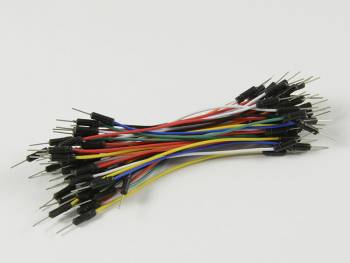
Allnet ALL-A-6 4duino Breadboard Cable Set
| Lieske Part No. | 634798 |
|---|---|
| Mfg Part No | ALL-A-6 (B11) |
| EAN-Code | 4038816025456 |
| Manufacturer | Allnet |
| Here only | 1,98 EUR
2,36 EUR incl. VAT
|
Further information for Allnet ALL-A-6 4duino Breadboard Cable Set
| General | |
| Number of contacts | 400 |
| Modular spacing | 2,54 mm |
| Rear side | Double-sided adhesive tape |
| Scope of delivery | 1 x Breadboard 400 Pins |
Applications
The breadboard is designed for use in prototyping and development phases where a flexible and repeatable circuit construction is required. It is suitable for applications in electronics and microcontroller development, especially in combination with platforms such as Arduino, Raspberry Pi, or similar systems. Typical use occurs in laboratory environments, schools, universities, or among hobby developers who wish to quickly test circuits without soldering.
Functions and Equipment in Detail
The breadboard features 400 contacts arranged in a 2.54 mm pitch. This dimension corresponds to the standard for many electronic components and enables compatible use with a wide range of parts such as resistors, capacitors, transistors, or integrated circuits. The dimensions of the breadboard are approximately 8.5 cm in length, 5.5 cm in width, and 0.85 cm in height. On the back, a double-sided adhesive tape is attached, allowing multiple breadboards to be mounted on top of each other, enabling modular expansion of the working surface. This construction is particularly advantageous when multiple circuits need to be built in parallel or in a more complex arrangement.
Technology Explained Simply
The breadboard operates on the principle of a universal prototyping board, where contacts are arranged in rows and electrically connected. The contacts are divided into two areas: the central rows are electrically connected within each column, while the outer rows (power and ground buses) are connected along the entire length of the board. This allows for easy supply of voltage and ground for the entire circuit. The use of 2.54 mm pitch ensures compatibility with a broad range of standard components. The double-sided adhesive tape on the back serves mechanical stabilization and allows mounting on flat surfaces or combining multiple boards into a larger working area.
Compatibility and Accessories
The breadboard is designed for use with components in the standard 2.54 mm pitch. It is therefore compatible with a wide variety of electronic components that feature this spacing. Combination with other 4duino products or similar development systems is possible, especially if they also use the 2.54 mm pitch. Mounting multiple boards using the double-sided adhesive tape allows expansion of the working surface, enabling more complex circuits to be realized.
Mounting and Installation
Mounting is done by attaching the breadboard to a flat surface using the double-sided adhesive tape on the back. The adhesive surface is designed to ensure the board adheres securely and does not easily detach. When using multiple boards, the adhesive tape can be used to fix the boards on top of each other. Electrical connections of components are made by inserting pins into the contacts of the board. Component positioning follows the circuit design, taking into account electrical connections within columns and power buses.
Advantages in Operation
The breadboard offers a quick and flexible way to build and test circuits without requiring soldering. The use of 2.54 mm pitch ensures broad compatibility with standard components. The ability to combine multiple boards using the double-sided adhesive tape extends functionality and enables realization of more complex projects. Mechanical stability provided by the adhesive tape ensures secure mounting, especially in mobile or vibrating environments. Use as a prototyping platform reduces development time and allows for rapid changes to the circuit. Batteries are not included in the delivery scope.

This is an offer of:
79279 Vörstetten
https://industry-electronics.com
Tel. 07666/88499-0
Fax. 07666/88499-111
Diesen Artikel finden Sie unter:
industry-electronics.com/artikel/634798

Lieske Elektronik e.K.
Reutener Str. 1079279 Vörstetten
https://industry-electronics.com
Tel. 07666/88499-0
Fax. 07666/88499-111
Diesen Artikel finden Sie unter:
industry-electronics.com/artikel/634798