
Allnet ALL-A-32 Soil Moisture Sensor
Maker > Sensors, Modules and Expansion Boards
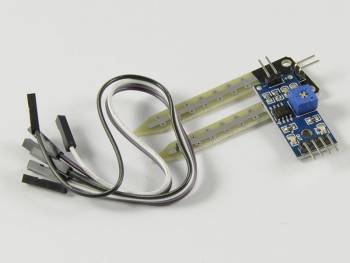
Allnet ALL-A-32 Soil Moisture Sensor
| Lieske Part No. | 634817 |
|---|---|
| Mfg Part No | ALL-A-32 (C27) |
| EAN-Code | 4038816025791 |
| Manufacturer | Allnet |
| Here only | 3,84 EUR
4,57 EUR incl. VAT
|
Further information for Allnet ALL-A-32 Soil Moisture Sensor
| General | |
| Manufacturer | Allnet |
| Compatibility | 4duino systems, microcontroller platforms with analog input |
Applications
The soil moisture sensor is primarily intended for use in agricultural or horticultural applications, where precise measurement of soil moisture is important for optimizing irrigation. It can be used in projects based on microcontroller platforms such as Arduino or compatible 4duino systems. The application typically takes place outdoors, for example in beds, greenhouses, or fields, where the sensor probe is inserted into the soil. The measurement is contact-based, with the sensor's electrodes detecting the electrical conductivity of the soil, which correlates with moisture content.
Functions and Equipment in Detail
The module features a sensor unit with two metallic electrodes, which are inserted into the soil to measure moisture values. The output is an analog signal value, transmitted via a connection to a control device. The sensor probe is designed for direct installation in the soil, with the exact mounting depth and technique depending on the specific project. The sensor's output is not digitized and requires an analog interface on the control device to interpret the value. The sensor function is based on the electrical conductivity of the soil, which increases with rising moisture content.
Technology Explained Simply
The sensor uses the principles of electrical conductivity to determine soil moisture. The two electrodes, inserted into the soil, form an electrical resistance that depends on the moisture level. The wetter the soil, the better it conducts electricity, resulting in lower resistance. This resistance value is transmitted as an analog signal to the control device, where it can be converted into a moisture reading. The measurement does not require additional power supply for the sensor itself, as it is powered by the connected control device. The accuracy of the measurement depends on soil composition, temperature, and the cleanliness of the electrodes.
Compatibility and Accessories
The module is specifically developed for use with 4duino systems based on the Arduino platform. However, it can also be connected to other microcontroller platforms that have an analog input interface. The connection is made via a standardized connector, directly to the analog inputs of the control device. Use requires integration into an existing control system.
Installation and Mounting
Installation is done by inserting the sensor probe into the soil, ensuring the electrodes are fully embedded in the ground. The insertion depth depends on the specific application, typically between 5 and 20 cm. The sensor probe is not waterproof, and the electrodes may corrode with prolonged exposure to moisture. Regular cleaning of the electrodes is recommended to maintain measurement accuracy. Connection to the control device is made via a cable directly attached to the module's connector.
Advantages in Operation
The sensor enables continuous and automated monitoring of soil moisture, increasing the efficiency of irrigation systems. Integration into existing control systems is simple, as no additional power supply is required for the sensor. The analog output allows flexible use in various projects based on microcontroller platforms. The measurement is taken directly in the soil, enabling accurate assessment of local moisture conditions. The sensor probe is robust enough for outdoor use, but requires regular maintenance, especially with long-term use in moist environments.

This is an offer of:
79279 Vörstetten
https://industry-electronics.com
Tel. 07666/88499-0
Fax. 07666/88499-111
Diesen Artikel finden Sie unter:
industry-electronics.com/artikel/634817

Lieske Elektronik e.K.
Reutener Str. 1079279 Vörstetten
https://industry-electronics.com
Tel. 07666/88499-0
Fax. 07666/88499-111
Diesen Artikel finden Sie unter:
industry-electronics.com/artikel/634817