
Allnet ALL-A-27 4duino Temperature Sensor Waterproof
Maker > Sensors, Modules and Expansion Boards
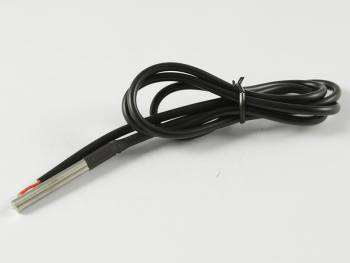
Allnet ALL-A-27 4duino Temperature Sensor Waterproof
| Lieske Part No. | 634734 |
|---|---|
| Mfg Part No | ALL-A-27 (C1) |
| EAN-Code | 4038816024275 |
| Manufacturer | Allnet |
| Here only | 3,40 EUR
4,05 EUR incl. VAT
|
Further information for Allnet ALL-A-27 4duino Temperature Sensor Waterproof
| General | |
| Temperature range | -55 to +125 °C |
| Resolution | 9-12 bit |
| Accuracy | ±0,5 °C |
| Operating voltage | 3.0 to 5.5 V |
| Cable length | 100 cm |
| Degree of protection | Water-tight welded |
| Interface | 1-Wire |
| Pull-up resistor | external required, recommended 4.7 kΩ |
Applications
This sensor is suitable for a wide range of applications where reliable temperature measurement under harsh conditions is required. These include HVAC systems, industrial process monitoring, machine monitoring, environmental measurements, or in agriculture for monitoring storage or climate conditions. The waterproof design makes it particularly suitable for use in wet areas, such as in cooling or heating systems, fluid monitoring, or in the food industry.
Features and Specifications in Detail
The DS18B20 offers a resolution that is adjustable between 9 and 12 bits, allowing the measurement accuracy to be adapted to specific requirements. At a resolution of 12 bits, the maximum conversion time is 750 milliseconds. Temperature measurement is calibrated to ±0.5°C in the range of -10°C to +85°C. Each sensor has a unique 64-bit serial number, enabling multiple sensors to operate on the same 1-Wire line without requiring additional addressing. This significantly simplifies the installation of decentralized temperature measurement systems.
Technology Explained Simply
The sensor communicates via a 1-Wire interface, requiring only a single data cable (and ground) to communicate with a central microcontroller. The operating voltage ranges from 3.0 V to 5.5 V. An external pull-up resistor is required for proper operation, with a value of 4.7 kΩ recommended. The cable length is approximately 100 cm, with the sensor itself measuring about 50 mm in length, of which 30 mm is bare, and having a diameter of 6 mm.
Compatibility and Accessories
The sensor is compatible with a variety of microcontroller platforms, particularly Arduino-based systems that feature a 1-Wire library. The cable wiring is flexible: red for VCC, blue, yellow, or green for data, and black or yellow for GND. The use of an external pull-up resistor is necessary to ensure reliable communication over the 1-Wire interface. The waterproof stainless steel sleeve allows use in damp or wet environments, with the welding providing permanent protection.
Mounting and Installation
Installation is performed by directly placing the sensor into the environment to be measured. The stainless steel sleeve can be immersed in liquids, placed in air, or mounted on surfaces. The 100 cm cable length allows for flexible positioning of the sensor relative to the control unit. Connection is made via the three wires (VCC, data, GND), with the exact color coding varying depending on the connection configuration. Installation requires no additional components other than the recommended pull-up resistor.
Operational Advantages
The sensor offers high reliability due to the waterproof stainless steel sleeve and the robust 1-Wire technology. The ability to operate multiple sensors on a single line reduces cable complexity and simplifies system architecture. The digital output of temperature values minimizes errors from analog-to-digital conversion and enables precise, noise-free measurement. The operating voltage range of 3.0 to 5.5 V makes the sensor compatible with a wide range of microcontroller systems.

This is an offer of:
79279 Vörstetten
https://industry-electronics.com
Tel. 07666/88499-0
Fax. 07666/88499-111
Diesen Artikel finden Sie unter:
industry-electronics.com/artikel/634734

Lieske Elektronik e.K.
Reutener Str. 1079279 Vörstetten
https://industry-electronics.com
Tel. 07666/88499-0
Fax. 07666/88499-111
Diesen Artikel finden Sie unter:
industry-electronics.com/artikel/634734