
Diverse 2006240 connection cable 6 mm² 5 m
Medical Technology > Electrical Insulation
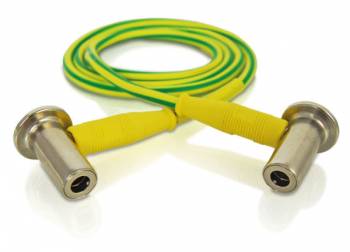
Diverse 2006240 connection cable 6 mm² 5 m
| Lieske Part No. | 716122 |
|---|---|
| Mfg Part No | 2006240 |
| EAN-Code | |
| Manufacturer | Diverse |
| Here only | 66,67 EUR
79,34 EUR incl. VAT
|
Further information for Diverse 2006240 connection cable 6 mm² 5 m
| General | |
| Conductor cross-section | 6 mm² |
| Conductor diameter | 3.8 mm |
| Insulation colour | Green-yellow |
| Socket shape | 90° angled |
| Socket material | Nickel-plated brass |
| Contact blade material | Gold-plated hard copper alloy |
| Function | Potential equalization |
| Norm | DIN 42801 |
Applications
This connection cable is primarily intended for use in medical facilities, particularly in areas where reliable equipotential bonding is required, such as operating rooms, intensive care units, or during the installation of medical devices. DIN 42801 specifies the requirements for equipotential bonding in medical facilities, which is why this cable was specifically developed for this application. The green-yellow insulation and the specific design of the sockets ensure that the cable is clearly identifiable as a protective conductor connection, thus preventing incorrect connections.
Functions and Equipment in Detail
At both ends of the cable, 90° angled sockets are mounted, equipped with a spring-loaded contact blade. This design ensures a secure and durable electrical connection, even under mechanical stress or vibrations. The sockets are made of nickel-plated brass, offering high corrosion resistance and good electrical conductivity. The contact blade is made of gold-plated hard copper alloy, providing additional resistance to oxidation and wear, ensuring a reliable connection over a long period.
Technology Explained Simply
The green-yellow insulation is the standardized marking for protective conductors according to VDE 0100 and DIN VDE 0100-510, meaning this cable may only be used for the protective earth conductor (PE). The 90° sockets allow for a compact and space-efficient installation, especially in tight installation situations where a straight socket would not fit. The spring-loaded contact blade ensures that the connection remains intact even with slight movement or thermal expansion, which is crucial for safety in medical facilities.
Compatibility and Accessories
The connection cable is designed for use in medical facilities and complies with the requirements of DIN 42811. It can be combined with other components of the equipotential bonding system, particularly with protective earth conductor outlets, switch boxes, or medical devices requiring a protective earth connection. The sockets are designed to fit standard sockets or terminals intended for protective earth connections.
Installation and Mounting
Installation is carried out by inserting the 90° sockets into appropriate sockets or terminals designated for the protective earth conductor. The spring-loaded contact blade ensures a secure fit, with mechanical strength guaranteed by the material selection (nickel-plated brass, gold-plated hard copper alloy). The cable is intended for fixed installation and should not be operated under tension. The green-yellow marking facilitates identification during installation and maintenance.
Operational Advantages
The connection cable provides a reliable and durable connection for equipotential bonding, increasing safety in medical facilities. The materials ensure high corrosion resistance and electrical conductivity, extending the cable's service life. The 90° sockets enable space-efficient installation, and the green-yellow insulation ensures clear identification, minimizing installation errors. Compliance with DIN 42801 ensures the cable meets the specific requirements of medical installations.

This is an offer of:
79279 Vörstetten
https://industry-electronics.com
Tel. 07666/88499-0
Fax. 07666/88499-111
Diesen Artikel finden Sie unter:
industry-electronics.com/artikel/716122

Lieske Elektronik e.K.
Reutener Str. 1079279 Vörstetten
https://industry-electronics.com
Tel. 07666/88499-0
Fax. 07666/88499-111
Diesen Artikel finden Sie unter:
industry-electronics.com/artikel/716122