
Diverse 2005717 Connection Cable ISO 4mm² 3m
Medical Technology > Electrical Insulation
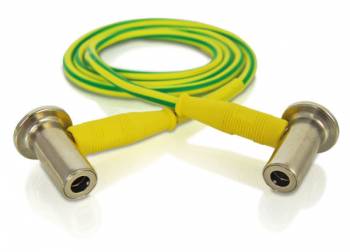
Diverse 2005717 Connection Cable ISO 4mm² 3m
| Lieske Part No. | 235197 |
|---|---|
| Mfg Part No | 2005717 |
| EAN-Code | |
| Manufacturer | Diverse |
| Here only | 42,55 EUR
50,63 EUR incl. VAT
|
Further information for Diverse 2005717 Connection Cable ISO 4mm² 3m
| General | |
| Conductor cross-section | 4 mm² |
| Insulation colour | Green-yellow |
| Connection type | 90° angled socket |
| Contact type | spring-loaded contact blade |
| Insulation coating | moulded |
| Norm | DIN 42801 |
Equipotential bonding is a central component of electrical safety in medical facilities, particularly in areas where patients come into contact with electrical devices. The cable ensures that all metallic parts that can be touched are at the same electrical potential, thereby reducing the likelihood of electric shocks.
Functions and equipment in detail
The cable features a conductor cross-section of 4 mm², ensuring sufficient current-carrying capacity and mechanical stability. The insulation is in the identification colour green-yellow, which is internationally recognized as the marking for protective conductors (PE conductors). At both ends of the cable, 90° angled sockets are mounted, equipped with a spring-loaded contact blade. This design enables a secure and durable connection, even under mechanical stress. The sockets are additionally overmoulded, providing additional mechanical stability and protection against external influences.
Technology explained simply
The conductor cross-section of 4 mm² ensures sufficient electrical conductivity to safely conduct required fault currents. The green-yellow insulation is marked according to international standards as a protective conductor and facilitates identification during the installation process. The 90° angled sockets allow for compact installation, especially in tight installation situations, and the spring-loaded contact blade ensures a secure electrical connection that remains uninterrupted even under vibration or movement. The overmoulded insulation protects the contact points from contamination and mechanical wear.
Compatibility and accessories
The cable is designed for use in medical electrical installations and complies with the requirements of DIN 42801. It can be combined with other components of the equipotential bonding system, such as earthing terminals or protective conductor connection outlets, to create a complete earthing system. The sockets are designed for standard connection points commonly used in medical installations.
Installation and mounting
Mounting is performed by inserting the 90° angled sockets into corresponding connection points, with the spring-loaded contact blade ensuring a secure electrical connection. The cable is 3 m long, allowing flexible placement in various installation scenarios. The green-yellow identification colour facilitates recognition during installation and maintenance.
Advantages in operation
The cable provides a reliable and durable connection for equipotential bonding. The spring-loaded contact blade ensures a stable electrical connection, even under mechanical stress. The overmoulded insulation increases the service life and safety of the connection. The length of 3 m allows flexible adaptation to different installation scenarios without requiring additional extensions. Compliance with DIN 42801 ensures conformity with applicable safety standards in medical facilities.

This is an offer of:
79279 Vörstetten
https://industry-electronics.com
Tel. 07666/88499-0
Fax. 07666/88499-111
Diesen Artikel finden Sie unter:
industry-electronics.com/artikel/235197

Lieske Elektronik e.K.
Reutener Str. 1079279 Vörstetten
https://industry-electronics.com
Tel. 07666/88499-0
Fax. 07666/88499-111
Diesen Artikel finden Sie unter:
industry-electronics.com/artikel/235197