
Diverse 2005710 connection cable 4 mm² 1 m
Medical Technology > Electrical Insulation
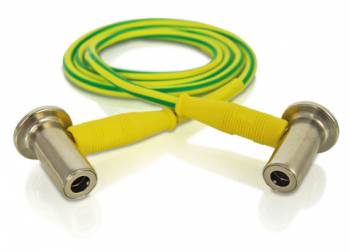
Diverse 2005710 connection cable 4 mm² 1 m
| Lieske Part No. | 795217 |
|---|---|
| Mfg Part No | 2005710 |
| EAN-Code | |
| Manufacturer | Diverse |
| Here only | 34,69 EUR
41,29 EUR incl. VAT
|
Further information for Diverse 2005710 connection cable 4 mm² 1 m
| General | |
| Conductor cross-section | 4 mm² |
| Insulation colour | Green-yellow |
| Socket material | Nickel-plated brass |
| Contact blade material | Gold-plated hard copper alloy |
| Socket angle | 90° |
| Application | Equipotential bonding in accordance with DIN 42801 |
Equipotential bonding is a central component of electrical safety in medical facilities, as it ensures that all metallic parts within a room are at the same electrical potential, preventing dangerous voltage differences. The connection cable performs the function of linking two or more earthing points or protective conductors, ensuring a safe and conductive path for any fault currents.
Functions and equipment in detail
The cable is fitted with 90° angled terminals on both ends, enabling a secure and mechanically stable connection. The terminals are made of nickel-plated brass, ensuring high corrosion resistance and good electrical conductivity. The spring-loaded contact blade, made of gold-plated hard copper alloy, ensures a reliable electrical connection, even under mechanical stress or vibrations. The gold plating prevents oxidation and increases the lifespan of the connection.
Technology explained simply
The conductor cross-section of 4 mm² ensures sufficient current-carrying capacity and minimizes resistance, which is important for safe operation under high fault currents. The green-yellow insulation is mandated by VDE and DIN standards for protective conductors and serves as a visual identifier to prevent confusion with other cables. The 90° terminals allow for compact installation, especially in tight installation situations, and reduce mechanical stress on the cable due to the connection.
Compatibility and accessories
The connection cable is designed for use in medical facilities, where requirements for electrical safety are particularly high. It is compatible with standard earthing terminals and protective conductor connection points provided in medical devices and installations. It is used in conjunction with other components of the equipotential bonding system, such as earthing rails or protective conductor connection boxes, which must also comply with DIN 42801.
Installation and mounting
Installation is carried out by inserting the terminals into the corresponding connection points, where the spring-loaded contact blade ensures a secure electrical connection. The 90° angle of the terminals facilitates installation, especially in confined spaces. The cable is designed for a permanent connection and should not be operated under tension or mechanical load. Installation is performed as part of electrical installation work in accordance with applicable regulations and standards.
Advantages in operation
The connection cable provides a reliable and durable connection for equipotential bonding. The materials — nickel-plated brass and gold-plated hard copper alloy — ensure high corrosion resistance and electrical conductivity. The green-yellow insulation ensures clear identification, simplifying maintenance and inspection. The 1-meter length offers sufficient flexibility for typical applications in medical rooms.
The cable is specifically designed for use in medical facilities, where the safety of patients and personnel is the highest priority. Compliance with DIN 42801 ensures that the cable meets the specific requirements for electrical insulation and earthing in medical environments.

This is an offer of:
79279 Vörstetten
https://industry-electronics.com
Tel. 07666/88499-0
Fax. 07666/88499-111
Diesen Artikel finden Sie unter:
industry-electronics.com/artikel/795217

Lieske Elektronik e.K.
Reutener Str. 1079279 Vörstetten
https://industry-electronics.com
Tel. 07666/88499-0
Fax. 07666/88499-111
Diesen Artikel finden Sie unter:
industry-electronics.com/artikel/795217