
Diverse 130005001-I ISDN socket 2x8(4) 4-pole surface mount RJ12+RJ45
Telecommunication > Junction boxes > ISDN
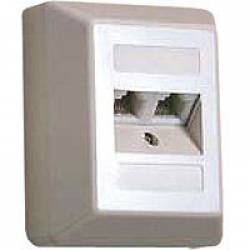
Diverse 130005001-I ISDN socket 2x8(4) 4-pole surface mount RJ12+RJ45
| Lieske Part No. | 497256 |
|---|---|
| Mfg Part No | 130005001-I |
| EAN-Code | 4250184100546 |
| Manufacturer | Diverse |
| Here only | 6,81 EUR
8,10 EUR incl. VAT
|
Further information for Diverse 130005001-I ISDN socket 2x8(4) 4-pole surface mount RJ12+RJ45
| General | |
| Connections | 2xRJ45 8P4C |
| Colour | pearl white |
| Colour code | RAL 1013 |
| Connection type | Screw terminals |
| Maximum number of cores per terminal | 3 |
| Conductor diameter | 0.4 to 0.8 mm |
| Angle of plug | 45° |
| Socket connection | Parallel |
| Application type | Surface mounted (plaster) |
| Application | Bus wiring |
Surface-mounted socket
The socket is designed as a surface-mounted version, meaning it is mounted directly onto the wall without requiring a cutout in the wall structure. Installation is carried out on the wall surface, with the socket securely fixed using integrated mounting elements. The 45° insertion angle of the sockets ensures that the connection cables from the end devices hang downward without any overhang. This improves organization and prevents unnecessary cable tangling.
Functions and equipment in detail
The two RJ45 sockets are equipped with screw terminals, allowing up to three conductors to be connected at each terminal point. The conductors must have a diameter of 0.4 to 0.8 mm to be securely inserted and screwed into the terminals. The release levers of the plugs are oriented upward, facilitating operation and enabling quick plug connections. The parallel connection of the sockets ensures that both connections use the same circuit, which is typical for ISDN cabling in bus topology.
Technology explained simply
The designation 8P4C (8-Pin, 4-Contact) describes the construction of the RJ45 socket, where eight contacts are arranged in the connector face, but only four are electrically active. This configuration is common for ISDN applications, where signals are transmitted via the four contacts. The parallel connection of the two sockets means both connections use the same cable strand, simplifying cabling and reducing the number of required lines. The screw terminals provide a mechanically stable and electrically reliable connection, suitable for use in professional environments.
Compatibility and accessories
The socket is designed for use with ISDN end devices such as telephones, fax machines, or modems that feature an RJ45 connection. Cabling is performed in a bus topology, where multiple end devices are connected to a common cable strand. The socket is not suitable for PoE (Power over Ethernet), as no power supply is provided via the network cable. Compatibility is limited to use in ISDN networks, with cabling carried out according to common standards for ISDN connections.
Mounting and installation
Mounting is carried out on the wall, with the socket secured using integrated mounting elements. No additional mounting accessories are required. The cable connection is made via the screw terminals, using conductors with a diameter of 0.4 to 0.8 mm. The number of conductors connected per terminal point is limited to a maximum of three. The 45° insertion angle of the sockets facilitates installation, as cables hang downward and no additional fastening is required.
Advantages in operation
The socket provides a clear and organized connection option for two end devices in a bus topology. The parallel connection of the sockets reduces the number of required cables and simplifies cabling. The screw terminals ensure a stable and reliable electrical connection. The 45° insertion angle and upward-oriented release levers improve usability and facilitate easy insertion and removal of plugs. The pearl white color (RAL 1013) blends visually into most indoor environments and provides a professional appearance.

This is an offer of:
79279 Vörstetten
https://industry-electronics.com
Tel. 07666/88499-0
Fax. 07666/88499-111
Diesen Artikel finden Sie unter:
industry-electronics.com/artikel/497256

Lieske Elektronik e.K.
Reutener Str. 1079279 Vörstetten
https://industry-electronics.com
Tel. 07666/88499-0
Fax. 07666/88499-111
Diesen Artikel finden Sie unter:
industry-electronics.com/artikel/497256